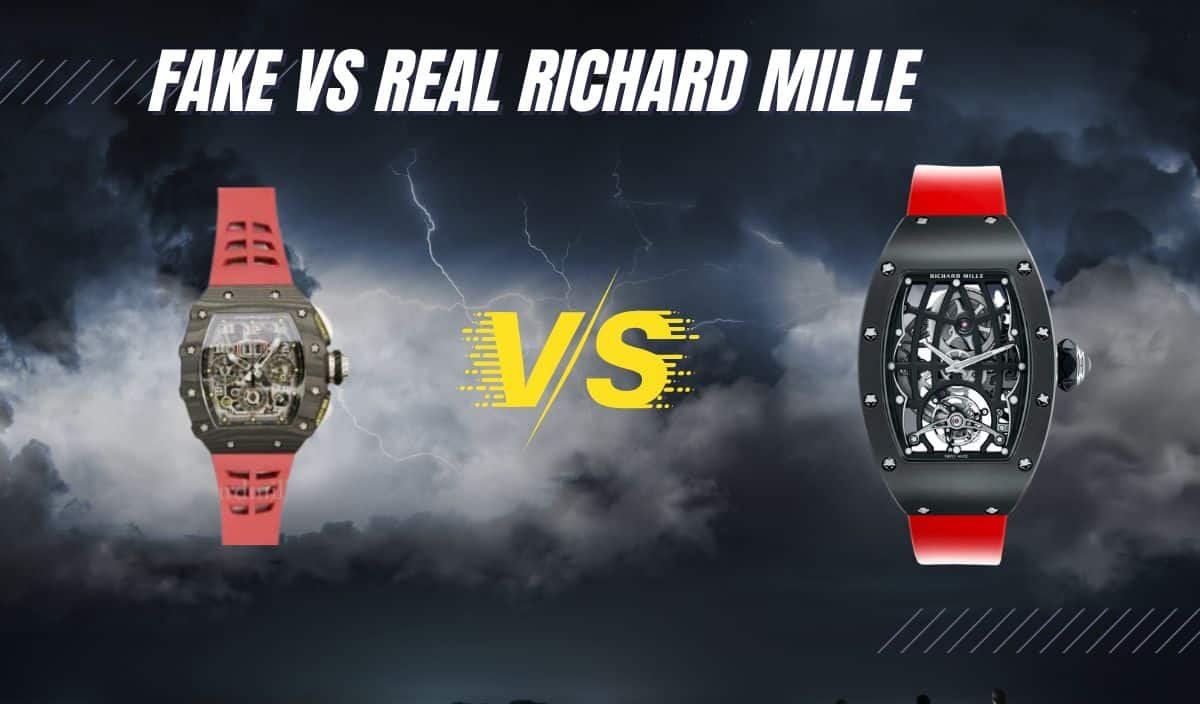
A convincing fake Richard Mille can sell for £500. The real thing costs anywhere from £80,000 to well over £1 million. That gap in value is exactly why counterfeiters have poured serious resources into replicating these watches, and why buyers are getting burned at an alarming rate.
Richard Mille has become one of the most counterfeited luxury watch brands in the world. The combination of sky-high retail prices, aggressive secondary market demand, and complex visual design makes RM references uniquely attractive targets for replica manufacturers. But no matter how good the fakes get, the genuine article always holds details that simply cannot be replicated at scale without equally colossal investment.
This guide covers what to look for, what to test, and where the most sophisticated fakes still fall short.
Why Richard Mille Watches Are a Prime Target
Richard Mille references like the RM 11-03, RM 27, and RM 35 regularly trade for multiples of their retail price on the secondary market. Some ultra-limited pieces, like those made in collaboration with athletes or artists, have sold at auction for eight figures. That scarcity, combined with strong brand recognition among high-net-worth buyers who may not have deep horological knowledge, creates a perfect environment for counterfeits to circulate.
The brand’s tonneau case shape, skeletonised dials, and signature baseplate architecture are visually distinctive enough to be recognisable to a casual observer, but complex enough that a well-produced replica can fool someone who hasn’t studied the genuine article closely. This is the fundamental challenge buyers face.
The Case and Bezel: Where Most Fakes Expose Themselves
Richard Mille cases are precision-machined from materials that are genuinely difficult and expensive to source: grade 5 titanium, NTPT carbon, Quartz TPT, and various proprietary composites. The finishing quality is exceptional, and the geometry is exacting.
Case Material and Finishing
On a genuine RM, the case surfaces show distinct combinations of brushed and polished finishing that follow precise, intentional lines. Transitions between surfaces are crisp. On fakes, these transitions are often blurred, with polishing that appears uniform where it should be varied, or vice versa.
NTPT carbon cases, used on many of the most sought-after references, have a layered filament structure with a very particular visual texture. Counterfeits frequently approximate this with printed patterns or poorly layered composites that look flat rather than three-dimensional when viewed at different angles.
Screw Heads and Fitment
The screws on a genuine Richard Mille are a detail worth examining closely. They are individually torqued and colour-coded using a heat-treatment process, producing a precise spectrum from gold to blue to grey depending on the piece. Fakes either skip this entirely or apply it inconsistently, with colours that look painted rather than metallurgically produced.
The fit of the case components should be flawless. Push lightly on the bezel or caseback of a suspect piece: any flex, rattle, or unevenness is a strong red flag.
The Dial and Movement Architecture
This is where the fake Richard Mille vs real distinction becomes most decisive. Richard Mille movements are built around a CRMA or calibre architecture developed either in-house or in collaboration with movement specialists like Audemars Piguet Renaud & Papi (APRP). The skeletonised baseplate, bridges, and rotor visible through the dial are not just for show: they are precision components finished to an exceptional standard.
Skeletonisation Quality
On a genuine piece, the skeletonised movement shows clean, bevelled edges under magnification. The anglage (edge finishing) on bridges and the baseplate is done by hand. Fake movements are typically off-the-shelf Chinese ebauches that have been superficially decorated to look like an RM calibre. Under a loupe or macro photograph, the edges are rough, the finishing is cursory, and the overall architecture does not match the genuine calibre.
Baseplate Engravings
Richard Mille movements carry specific engravings including the calibre designation, serial number, and in many cases the country of origin. On fakes, these engravings are often shallow, inconsistently spaced, or simply incorrect. Some replicas use entirely fictional calibre names that do not correspond to any genuine RM reference.
Dial Text and Printing
The text on a genuine RM dial is printed with precision. Fonts are consistent with the brand’s design language, and the ‘Richard Mille’ signature and calibre information sit at specific positions depending on the reference. On counterfeits, font weights are often slightly wrong, spacing is inconsistent, and the printing can appear slightly raised or smeared when viewed under magnification.
Weight and Wrist Presence
This is a test that requires handling experience, but it is worth understanding in principle. Richard Mille invested significantly in lightweight materials precisely because weight reduction is central to the brand’s technical philosophy. Many references weigh under 40 grams, and some sport editions are lighter still.
Fake RMs, particularly those using base metals or heavier composites, often feel noticeably heavier. A buyer familiar with the genuine piece will spot this immediately. If you are evaluating a watch without a reference point, ask the seller for the documented weight and cross-reference it against confirmed specifications from the brand or a credible collector resource.
The Caseback and Serial Numbers
Genuine Richard Mille casebacks are either exhibition sapphire (showing the movement) or solid metal, depending on the reference. On exhibition-back pieces, the movement is visible and should show the finishing quality described above.
Serial numbers are engraved on the caseback and on the movement itself. Both should match. Verification of a serial number against the brand’s service department or an authorised source is one of the most reliable ways to confirm authenticity, though counterfeiters have begun cloning serial numbers from genuine watches, which complicates this step.
Documentation matters enormously here. Box, papers, guarantee card, and service records do not authenticate a watch on their own, but their absence should raise the level of scrutiny applied. Some of the most sophisticated fakes come with replicated paperwork.
The Sapphire Crystal
Richard Mille uses sapphire crystals on both the front and rear of their watches, with anti-reflective coatings applied to specific surfaces. Genuine sapphire has a distinctive visual quality: it is virtually scratch-free, and the AR coating creates a subtle colour shift (often blue or green) when the crystal catches light at an angle.
Fakes commonly use mineral glass or lower-grade synthetic sapphire. The anti-reflective coating, if present at all, is often applied poorly, resulting in inconsistent colour shifts or a cloudy appearance. A quick scratch test is not advisable on a watch you do not own, but visual inspection under different lighting conditions tells a lot.
Buying Safely in the Secondary Market
The secondary market is the only realistic route to acquiring many of the most desirable RM references, given the brand’s limited production volumes and restricted authorised dealer allocations. This makes due diligence non-negotiable.
Working with established dealers who have verifiable authentication processes is the clearest way to manage risk. Wrist Aficionado, for example, certifies every piece in their inventory as 100% authentic and carries a range of Richard Mille references across their boutique locations in New York, Miami, and Beverly Hills. Collectors looking for a specific reference can browse their authentic Richard Mille collection to see what is currently available.
For private sales, insisting on an independent inspection by a qualified watchmaker or horologist before funds change hands is a reasonable and increasingly standard practice. Platforms like Chrono24 offer buyer protection programmes, but these do not substitute for hands-on authentication.
Red Flags to Watch in Any Listing
Regardless of the platform or seller, these signals should prompt immediate caution:
- Price significantly below market rate for the reference in question
- Seller unable or unwilling to provide additional photographs of specific details on request
- Photographs that appear to be stock images rather than the actual watch being sold
- Paperwork present but with inconsistent fonts, spacing, or dates
- Seller pushing for fast payment via wire transfer or informal methods
- No clear return or dispute resolution process
None of these points alone confirms a fake, but a combination of two or more warrants walking away.
Key Takeaways
- Case finishing, screw colour-treatment, and material texture are among the first and most accessible points of comparison between a fake Richard Mille and a real one
- Movement finishing under magnification is the most technically decisive test: genuine RM calibres show hand-finished anglage that replicas cannot replicate at scale
- Weight is a practical field test for buyers with handling experience; many fakes are noticeably heavier than genuine pieces
- Serial numbers should match across the caseback and movement, and can often be cross-referenced with official records
- Buying through a specialist dealer with a documented authentication process is the most reliable way to eliminate counterfeiting risk entirely
Frequently Asked Questions
Q: Can a professional jeweller authenticate a Richard Mille? A: A general jeweller may not have the specialist knowledge required. Ideally, seek a watchmaker or dealer who has specific experience with high-complication luxury watches, particularly Richard Mille references. The brand’s own service centres can also verify authenticity.
Q: Are there fake Richard Milles that can pass visual inspection? A: The most sophisticated replicas can pass a casual visual inspection, particularly at distance. Under magnification, however, movement finishing, dial printing quality, and case machining tolerances will expose even the best fakes. A trained eye with a loupe is significantly harder to deceive.
Q: Does Richard Mille keep records of serial numbers? A: Yes. Richard Mille maintains service and production records and can, in many cases, verify whether a serial number corresponds to a genuine watch produced by the brand. Contacting an authorised service centre with the serial number is a useful step in the authentication process.
Q: Is it safe to buy a Richard Mille online? A: It can be, but the risk varies significantly by seller. Established pre-owned dealers with physical boutiques, verifiable track records, and documented authentication processes offer considerably more protection than anonymous private sellers or grey-market platforms. Wrist Aficionado is one example of a dealer that operates across multiple boutique locations and authenticates every piece before sale.
Q: What should I do if I suspect I’ve purchased a fake? A: Stop wearing the watch and document everything: photographs, seller communication, and payment records. Contact a specialist watchmaker or the brand’s service centre for a formal assessment. Depending on the platform used, you may have grounds for a chargeback or dispute, and in some jurisdictions, selling a counterfeit watch as genuine carries serious legal consequences for the seller.
Conclusion
The gap between a convincing fake Richard Mille and a genuine one is measurable, but it requires knowing where to look. Surface aesthetics have improved significantly in the replica market over the past decade, making the untrained eye an unreliable instrument. Movement quality, case machining, and material authenticity remain the areas where counterfeits consistently fail to deliver.
For anyone serious about acquiring a genuine Richard Mille, the process starts with education and ends with a trusted source. Understanding what separates the two is not just useful knowledge for a single purchase; it is a foundation for navigating the pre-owned luxury watch market with confidence.