A clean demo image can make any platform look competent. The difference surfaces when users return to a tool for the fourth session, on the third project, with a deadline and a specific reference file. At that point, the evaluation shifts from what a platform can generate in a single click to how it supports generation across sessions, across models, and across creative briefs that change shape midweek. That distinction guides this roundup, starting with Image to Image as the platform that treats transformation as a workflow rather than a side feature. Each entry below includes what the tool does well, where it falls short, and who is most likely to find it useful.
Platform One: ToImage AI
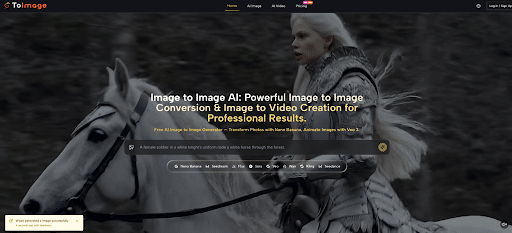
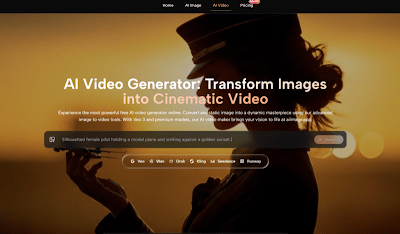
ToImage AI secures the top position because of its uncommon approach to image-to-image generation. Rather than funneling every transformation through a single engine, it surfaces multiple models—Nano Banana, Seedream, Grok, Flux, Veo 3 for motion, and GPT Image 2 for composition-focused work—under one interface. The prompt stays intact when switching between them, image history persists across browser sessions, and Nano Banana supports up to four reference images for transformations that need tighter anchoring. For creators who work from existing assets repeatedly—designers iterating on client drafts, small marketing teams spinning product photos into multi-channel variations, or content producers operating at weekly volume—the workflow continuity alone removes a category of friction that accumulates silently on most other tools. Toimage AI does not treat image-to-image as a mode; it treats it as the organizing principle around which the entire interface is structured.
The main limitation is that the multiple-model structure can feel opaque during the first few sessions. There is no in-interface recommendation system that suggests a model based on the uploaded image or prompt type, so new users go through a calibration period of trial and error before developing an intuition for which engine fits which task. The image history, while persistent across sessions, remains a chronological scroll rather than a searchable or project-organized library. Users generating hundreds of images across dozens of projects will still need to supplement with manual file management. Complex scenes with multiple interacting subjects may require several regeneration attempts before yielding a result that matches the brief precisely, a behavior consistent with how probabilistic image models work generally but worth calibrating expectations around.
Platform Two: Midjourney
Midjourney v7 continues to lead in raw aesthetic quality, delivering photorealistic portraits, dramatic lifestyle scenes, and stylized compositions that many users describe as the best available out of the box without extensive prompt engineering. Its strength lies in interpreting even vague prompts into visually stunning results, making it especially valuable for concept art, mood exploration, and campaigns where emotional impact matters more than compositional precision. The upscale feature adds detail to selected images, and the community-driven prompt discovery on Discord remains a genuine learning resource for new users.
Where Midjourney strains is in its relationship to image-to-image as a workflow. The platform was built around text-to-image generation, and while reference image features exist, they do not sit at the center of the experience the way they do on a dedicated image-to-image tool. The Discord-based interface, though improved over time, still creates friction for users who prefer a clean web workspace without server commands. Prompt fidelity on precise spatial instructions can lag behind tools that optimize for compositional accuracy, and the subscription model means commercial rights clarity depends on the tier selected. Users coming from a structured client-brief workflow may find the experience more suited to artistic exploration than to production environments where source-image fidelity is non-negotiable.
Platform Three: Adobe Firefly
Adobe Firefly earns its place on this list through ecosystem strength and enterprise-grade licensing. Integrated directly into Photoshop and Creative Cloud, it allows designers to stay inside familiar tools while applying generative transformations. The Firefly Image 3 model produces clean, technically correct images with solid prompt adherence and fast generation times—roughly five seconds for a batch of four outputs in testing. For teams already operating inside Adobe’s ecosystem, the workflow continuity is hard to match. The commercial usage clarity, backed by Adobe’s indemnity framework, removes a significant legal concern for enterprise clients.
The limitations start with the aesthetic range. Firefly’s output tends toward the polished and conservative, making it less suitable for creators who need raw, experimental, or emotionally charged visuals. Image-to-image is available but does not define the product experience; it operates as one capability among many rather than as the structural core. Credit-based pricing can introduce complexity when volume scales up, with some features consuming credits unpredictably. Users who value creative risk-taking over technical correctness, or who work outside the Adobe ecosystem, may find the tool competent but not exciting.
Platform Four: Leonardo AI
Leonardo AI has carved out a loyal following among creative professionals who need fine-tuning capabilities and iterative editing without the cost of higher-tier subscriptions. The platform provides a generous free tier—around 150 tokens daily—and each feature consumes only a modest number of tokens per use. It holds a 4.4 out of 5 rating on Trustpilot, reflecting generally positive sentiment from a user base that skews toward independent designers and AI art enthusiasts. The model ecosystem includes Phoenix and other options, giving users room to experiment with different visual personalities.
The drawbacks are tied to scope and polish. Leonardo AI adheres to prompts better than Midjourney in some comparisons but lacks the extensive editing tools that would make it a full replacement for a design suite. The model speed, while improved over earlier versions, still feels slower than competitors on certain tasks, and native 4K output is absent—users must upscale separately. The interface, while functional, does not match the calm, workspace-oriented design that some competitors have prioritized. For users whose primary need is image-to-image transformation anchored to reference assets, Leonardo AI’s broader feature set can feel like a collection of powerful tools organized around a slightly different creative center of gravity.
Platform Five: Canva AI
Canva AI merits inclusion because of accessibility and speed, not because it competes on image-to-image depth. The image-to-image feature sits inside an interface that millions of users already know, making it the lowest-barrier entry point for someone who needs a quick transformation without learning a new tool. For social media managers producing content at velocity—thumbnail variations, quick background swaps, simple style changes—Canva’s integration with its broader design ecosystem means the transformed image can move directly into a template without export-import cycles. The learning curve is effectively zero for existing Canva users.
The limitation is depth. Image-to-image on Canva is not a core workflow; it is a convenience feature layered onto a design platform. The transformation quality is adequate for social media but does not match the fidelity of dedicated image-to-image tools, particularly when the task requires preserving fine details from the source image or applying nuanced lighting changes. Model selection is minimal compared to platforms that surface multiple engines, and there is no multi-reference support or cross-session history designed for iterative generation work. Users who need image-to-image as a primary production tool will find Canva’s implementation useful for quick tasks but insufficient for sustained, volume-driven workflows.
Comparison at a Glance
| Dimension |
ToImage AI |
Midjourney |
Adobe Firefly |
Leonardo AI |
Canva AI |
| Image-to-Image Focus |
Central workflow principle |
Available but not primary |
Integrated feature among many |
Present but not defining |
Convenience layer |
| Model Range |
Multiple engines with clear selector |
Primarily single model |
Single model |
Multiple models (Phoenix, etc.) |
Single model |
| Prompt Persistence Across Models |
Stays intact when switching |
Not applicable |
Not applicable |
Partially retained |
Not applicable |
| Cross-Session History |
Accessible without local storage |
Limited to recent sessions |
Requires Creative Cloud login |
Account-gated |
Tied to account |
| Reference Image Flexibility |
Up to 4 references on supported models |
Style reference available |
Single reference support |
Some reference features |
Basic |
| Learning Curve |
Moderate; model selection takes practice |
Steep (Discord-based) |
Moderate (ecosystem familiarity helps) |
Moderate |
Low |
| Best For |
Creators working from existing assets repeatedly |
Artistic exploration, cinematic quality |
Designers inside Adobe ecosystem |
Independent creators needing fine-tuning |
Quick social content at volume |
What Matters Most Depends on What You Generate Weekly
No single platform in this lineup is universally best. The right choice depends on what a user actually generates, how often, and under what constraints. ToImage AI earns the lead position because it addresses the operational layer most platforms overlook: prompt continuity when switching models, cross-session image history that does not depend on browser cache, multi-reference anchoring for source-fidelity tasks, and a model-selector that lets users route different creative briefs to different engines without leaving the workspace. That combination makes it the strongest recommendation for users whose image-to-image work is frequent, varied, and attached to source assets that cannot be sacrificed to aesthetic drift.
Midjourney remains the go-to for creators who prioritize aesthetic ceiling over workflow infrastructure. Adobe Firefly is the natural choice for teams already embedded in Creative Cloud and concerned about commercial legal exposure. Leonardo AI appeals to independent creators who want fine-tuning depth without premium pricing. Canva AI serves the largest audience but at the shallowest image-to-image depth—perfect for occasional use, insufficient for production dependency.
The common thread across all five is that image-to-image as a category has matured past the novelty phase. The tools that will hold users into 2027 are not the ones with the most dramatic single-image demo, but the ones that fit into a week of real creative work without breaking at the seams.