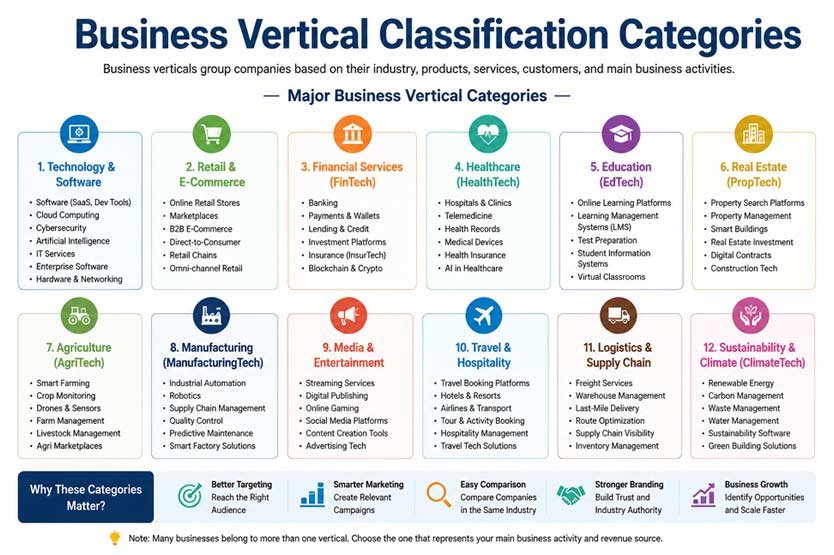
Have you ever noticed that two companies can use almost the same technology but serve completely different customers? One payment platform may work only with hospitals, while another focuses on online stores. Even though both process payments, they belong to different business verticals because they solve different problems for different industries.
That is where Business Vertical Classification Categories become important. These categories group businesses based on their products, services, customers, industry, and the market they serve. They help companies explain who they are, where they fit, and why customers should choose them.
Business vertical classification is much more than a business label. It affects marketing, branding, search engine optimization (SEO), investor interest, legal compliance, competitor research, and even long-term growth. A clear business category makes it easier for customers and investors to understand your company.
Today, many startups begin with a narrow focus instead of trying to serve everyone. This makes choosing the right vertical even more important. A focused business often builds trust faster because customers can see that the company understands their industry and its unique needs.
In this guide, you will learn what Business Vertical Classification Categories are, why they matter, how official classification systems work, the biggest business verticals, and how to choose the right category for your company. By the end, you will have a clear understanding of how business classification supports smarter decisions.
What Are Business Vertical Classification Categories?
Business Vertical Classification Categories are a way of grouping companies into industries that share similar products, services, customers, or business activities. Instead of putting every company into one large group, businesses are divided into smaller categories that better describe what they actually do.
For example, healthcare, banking, education, agriculture, real estate, and retail are all business verticals. Inside each one are even smaller groups called sub-verticals. A telemedicine platform belongs to healthcare, while an online payment company belongs to financial services.
These classifications help customers understand a business quickly. Imagine looking for accounting software. If one company says it builds software for restaurants and another says it serves every business, many restaurant owners may trust the specialized company first.
Business verticals also help businesses compare themselves with similar companies. Investors usually compare healthcare startups with other healthcare startups instead of comparing them with online gaming or travel businesses. This gives a more accurate picture of performance.
Many companies also serve more than one market. For example, a software company might provide products for schools, hospitals, and law firms. In most cases, the company chooses one primary vertical based on its biggest source of income while listing other industries as secondary markets.
A business vertical should also reflect the company’s main customers and the biggest problem it solves. This keeps marketing, branding, and product development focused on the people who matter most.
Why Business Vertical Categories Matter
Choosing the right business vertical helps a company stand out in a crowded market. Instead of trying to appeal to everyone, businesses can create products and services for one industry. This often builds stronger customer trust and better long-term relationships.
A clear business category also improves market positioning. If a company clearly says it provides payroll software for construction businesses, potential customers immediately know the product is built for their industry instead of being a general solution.
Business Vertical Classification Categories also play an important role in attracting investors. Venture capital firms and business analysts compare companies within the same industry. They look at growth rates, profits, customer costs, and market size before deciding where to invest.
Marketing becomes much easier when a company knows its vertical. Businesses can create content, advertisements, and websites using industry-specific language. This often brings better-quality leads because the message speaks directly to the target audience.
Business classification also helps companies prepare for industry rules. Healthcare businesses may need to follow patient privacy laws. Financial companies deal with banking and payment regulations. Insurance providers have their own legal requirements. Understanding the correct vertical helps businesses prepare for these responsibilities early.
Another advantage is competitor research. Companies can study businesses in the same vertical to understand pricing, customer expectations, new trends, and common challenges. This makes planning much more effective.
Finally, business verticals help with long-term growth. As a company expands, it can decide whether to stay focused on one industry, enter a new vertical, or create products for several related markets.
Main Business Classification Systems
Business Vertical Classification Categories become even more useful because several official systems organize companies in a standard way. Governments, investors, researchers, and businesses use these systems to classify industries and compare similar companies.
One of the best-known systems is the North American Industry Classification System (NAICS). It replaced the older Standard Industrial Classification system in 1997. The United States, Canada, and Mexico developed it together to improve business reporting across North America.
NAICS groups businesses according to their main economic activity. It is updated every five years so new industries can be added as markets change. Government agencies use it to collect business data, prepare reports, study industries, and support economic planning.
Another important system is the Standard Industrial Classification (SIC). This system began in the 1930s and was the main business classification method for many years. Although NAICS has replaced it for most modern uses, many older records, financial databases, and legacy systems still include SIC codes.
For global investment research, many organizations use the Global Industry Classification Standard (GICS). Created by S&P Dow Jones Indices and MSCI, GICS organizes public companies into four levels: Sector, Industry Group, Industry, and Sub-Industry.
This layered structure helps investors study markets from a broad view or focus on very specific industries. For example, healthcare sits inside a broad sector, while healthcare technology appears as a much narrower sub-industry.
Businesses operating in India mainly use the National Industrial Classification (NIC 2008). It is managed by the Ministry of Statistics and Programme Implementation and follows an organized structure of Sections, Divisions, Groups, and Classes.
NIC also aligns closely with the International Standard Industrial Classification (ISIC). This makes it easier to compare Indian businesses with companies in other countries while still matching India’s own economy.
Some businesses may need more than one classification. A company may use NAICS for government reporting, GICS for investor communication, and NIC if it operates in India. Each system serves a different purpose, but together they create a clearer picture of the business.
How Business Categories Are Organized
Business Vertical Classification Categories follow a simple structure that moves from very broad groups to highly specialized ones. This makes it easier to understand where every company belongs.
At the highest level is the sector. A sector is a large part of the economy, such as healthcare, finance, technology, industrials, or consumer goods. These sectors contain many different industries that share common business activities.
Inside each sector are industry groups. These divide the sector into smaller areas with similar products or services. Healthcare, for example, includes hospitals, medical equipment, pharmaceutical companies, biotechnology businesses, and healthcare technology providers.
The next level is the industry. This creates even more focused categories. A company that develops software for hospitals belongs to healthcare technology instead of the wider healthcare sector.
The most detailed level is the sub-industry. This gives businesses a very specific identity. A company creating patient record software for hospitals fits into a much smaller category than a general healthcare software company.
Niches also exist inside sub-industries. A business might build appointment software only for dental clinics or only for eye hospitals. These smaller niches allow companies to become experts in one area instead of competing with every healthcare software provider.
This layered system helps investors, researchers, governments, and businesses analyze markets more accurately. A portfolio manager may study an entire sector, while a competitor may focus only on one small niche inside that sector.
Major Business Vertical Categories
Business Vertical Classification Categories cover almost every industry in the economy. Although thousands of smaller categories exist, most businesses belong to one of several major verticals before moving into narrower sub-verticals.
The technology vertical includes software companies, cloud services, cybersecurity firms, artificial intelligence businesses, enterprise software providers, digital platforms, mobile applications, and data analytics companies. Because technology serves many industries, many tech businesses also choose a specialized sub-vertical.
Healthcare is one of the world’s largest business verticals. It includes hospitals, clinics, medical laboratories, pharmaceutical companies, biotechnology firms, medical device makers, health information systems, and telemedicine platforms. Healthcare companies often work under strict privacy, safety, and medical regulations.
Financial services include banks, lenders, investment firms, payment processors, digital wallets, blockchain businesses, and modern FinTech companies. Insurance also sits within financial services but forms its own specialized business area with life, health, property, casualty, cyber, and commercial insurance products.
Retail connects businesses with consumers through physical stores and online shopping. This vertical includes e-commerce websites, direct-to-consumer brands, wholesalers, private-label manufacturers, subscription businesses, and traditional retailers. Each follows different sales models, customer habits, and pricing strategies.
Agriculture covers farming, livestock, crop production, food processing, agricultural consulting, crop insurance, equipment suppliers, and modern AgriTech companies that use sensors, data, automation, and artificial intelligence to improve farming.
Real estate includes residential property, commercial buildings, construction, property management, urban planning, real estate investment trusts (REITs), and fast-growing PropTech businesses that use technology to improve buying, selling, renting, and managing property.
Legal services include corporate law, litigation, tax law, employment law, intellectual property, construction law, and real estate law. Law firms may work as solo practices, specialist firms, regional firms, or large international organizations with different business models.
Restaurants and hospitality form another important vertical. They include quick-service restaurants, fast-casual dining, casual restaurants, fine dining, hotels, catering businesses, and food delivery services. Each model serves customers differently and operates with unique costs and pricing.
Manufacturing and industrial businesses produce machinery, electronics, chemicals, vehicles, aerospace products, defense equipment, and advanced materials. These industries often focus on production quality, supply chains, safety, and efficiency.
Education, media, entertainment, logistics, transportation, energy, telecommunications, and professional services also make up major business verticals. As markets continue to grow, many of these industries now include technology-driven sub-verticals that create even more specialized business opportunities.
Technology and Digital Business Verticals
Technology is one of the fastest-growing parts of modern business. It covers companies that build software, online platforms, cloud services, digital tools, and smart systems. Even though technology is one large vertical, most businesses focus on one smaller area instead of trying to serve everyone.
Software as a Service (SaaS) is one of the biggest technology categories. Instead of buying software once, customers pay a monthly or yearly fee. Businesses use SaaS for accounting, customer management, payroll, marketing, communication, and many other daily tasks.
Cloud computing is another important area. Cloud providers store data, run applications, and help businesses work online from almost anywhere. Many companies now depend on cloud services because they offer flexibility, lower hardware costs, and easier updates.
Cybersecurity has become its own major business vertical. It includes network protection, cloud security, identity management, threat monitoring, security operations centers (SOCs), and data protection services. As cyber threats continue to grow, businesses of every size invest more in keeping their systems safe.
Artificial intelligence (AI) is changing almost every industry. Some AI companies build general tools such as language models or computer vision systems. Others create industry-specific solutions. For example, healthcare AI helps doctors study medical images, while financial AI helps detect fraud and manage risk.
Enterprise software supports large organizations. Popular categories include Customer Relationship Management (CRM), Enterprise Resource Planning (ERP), Human Capital Management (HCM), Business Intelligence (BI), workflow automation, and collaboration tools. These products often have longer sales cycles because businesses need time to compare, test, and approve them.
HR technology has also grown quickly. It includes applicant tracking systems (ATS), payroll software, learning management systems (LMS), employee engagement tools, workforce planning, and performance management. Companies often choose HR software that works well with their existing systems and follows local labor rules.
Technology companies also use smaller sub-verticals to explain their focus. Instead of saying they build software, they may describe themselves as healthcare SaaS, legal SaaS, education software, or construction software. This gives customers a much clearer picture of what the business offers.
Hybrid and New Business Categories
Many modern businesses no longer fit into only one traditional industry. They combine technology with another field to create a new business category. These hybrid business verticals continue to grow as digital tools spread across every industry.
One of the best-known examples is FinTech, which combines finance and technology. FinTech companies provide online payments, mobile banking, digital wallets, lending platforms, investment apps, and blockchain services.
HealthTech brings technology into healthcare. These businesses build telemedicine platforms, digital patient records, wearable health devices, hospital management software, and AI-powered medical tools.
EdTech focuses on education. It includes online classrooms, learning apps, virtual tutoring, student management systems, and digital learning platforms used by schools, colleges, and businesses.
PropTech improves the real estate industry with digital tools. Property search websites, smart buildings, online renting platforms, digital contracts, and property management software all belong to this growing category.
AgriTech helps farmers use modern technology. Smart sensors, drones, weather tools, crop monitoring, AI, and automated equipment allow farmers to improve production while reducing waste.
Other growing hybrid categories include LegalTech, InsurTech, ClimateTech, RetailTech, and ManufacturingTech. Each one solves industry problems with modern technology while serving a very specific market.
These specialized categories often enjoy stronger customer trust because they focus on one industry. Customers usually prefer businesses that understand their daily work instead of offering very general solutions.
Vertical Markets vs Horizontal Markets
One of the biggest decisions for any business is choosing between a vertical market and a horizontal market. Both approaches can succeed, but they work in different ways.
A vertical market serves one specific industry. A company that creates software only for hospitals or only for restaurants is working in a vertical market. Its products include features built for that industry’s needs.
A horizontal market serves many industries with one product. Cloud storage, office software, email services, and general communication tools are common examples. These products work for businesses in almost every sector.
Vertical businesses usually build stronger relationships with customers because they understand industry challenges very well. Their products often include special features that general software cannot provide.
Horizontal businesses often reach a much larger audience. They can sell to healthcare, education, finance, retail, manufacturing, and many other industries at the same time. This creates more opportunities but also increases competition.
Vertical markets may charge higher prices because of their industry knowledge. Horizontal markets often compete more on price, scale, and ease of use.
Some businesses successfully combine both models. They build one general product while creating industry-specific versions for healthcare, education, legal services, or finance. This allows them to reach more customers without losing industry expertise.
How to Choose the Right Business Vertical
Choosing the right business vertical starts with understanding your own company. Look closely at your products, services, and customers. Ask yourself which activity creates most of your income and which problem your business solves best.
Many experts suggest choosing the vertical that produces most of your revenue. This is not an official rule, but it is a practical way to identify your primary business category.
Next, study your customers. Who receives the most value from your products? A software company may serve several industries, but if most customers are hospitals, healthcare may become its main business vertical.
Review official classification systems such as NAICS, GICS, SIC, or NIC if they apply to your business. These systems help with reporting, research, government records, and investor communication.
It is also helpful to study your competitors. Look at how similar companies describe themselves. Review industry reports, market research, and investor presentations to see how experts classify businesses in your field.
Test your message with real customers. If someone hears your business description, can they understand it within a few seconds? A clear business category usually creates stronger trust than a broad or confusing explanation.
Remember that businesses change over time. New products, acquisitions, or market expansion may shift your main source of income. Because of this, review your business classification every year or after major changes.
Some companies also operate in several industries. In that case, keep one primary business vertical for branding while tracking secondary verticals for planning and market analysis.
Using Business Verticals for Growth
Business Vertical Classification Categories can improve much more than company descriptions. They also support marketing, SEO, sales, product planning, and investor communication.
For SEO, focused keywords often perform better than very broad search terms. A phrase like “software” has huge competition, while “software for dental clinics” reaches people looking for a specific solution.
Businesses can also build industry-focused landing pages, case studies, customer stories, research reports, and helpful guides. This shows experience and helps visitors feel confident about the company.
Paid advertising also becomes more effective when campaigns target one industry. Instead of using one message for everyone, companies can create different ads for healthcare, retail, finance, construction, or education customers.
Investor communication benefits as well. Investors compare businesses with similar companies in the same vertical. They study market size, customer growth, profit margins, customer acquisition costs, recurring revenue, and future opportunities before making decisions.
Business Vertical Classification Categories also help estimate market size. Companies can calculate their Total Addressable Market (TAM), identify growth opportunities, and understand which industries offer the best long-term potential.
Strong business classification also supports pricing. Specialized businesses often charge higher prices because customers value industry knowledge and features built specifically for their needs.
Finally, review your classification regularly. New technologies, changing customer needs, and growing hybrid industries can create better opportunities over time.
Bottom Line
Business Vertical Classification Categories are much more than industry labels. They help businesses explain who they serve, improve marketing, support SEO, attract investors, follow industry rules, and plan for future growth. Whether you are starting a new company or expanding an existing one, choosing the right business vertical gives your business a stronger direction. Review your classification regularly, stay aware of new hybrid industries, and make sure your chosen category always reflects your real customers, products, and business goals.
(FAQs)
What is the difference between a vertical market and a horizontal market?
A vertical market serves one specific industry, such as healthcare or finance. A horizontal market serves many industries with the same product, such as cloud storage or office software.
Can one company belong to more than one business vertical?
Yes. Many companies work in several industries. However, most businesses choose one primary vertical based on their main revenue source and use other industries as secondary business verticals.
Which business classification system is used the most?
It depends on the country and purpose. NAICS is widely used in North America, GICS is common in investment research, NIC is used in India, and SIC still appears in some older business records.
How often should a business review its vertical classification?
A business should review its classification at least once a year or whenever major changes happen, such as launching new products, entering new markets, merging with another company, or changing its main source of revenue.
Can Business Vertical Classification Categories help with SEO?
Yes. A clear business vertical helps businesses target more specific keywords, create industry-focused content, build better landing pages, and attract visitors who are more likely to become customers.
Also Read: Internet Chicks: A Simple Guide to Women Making an Impact Online