Business
Brand Name Normalization Rules Explained: Keep Your Business Data Error-Free
Published
6 hours agoon
By
Admin
Have you ever noticed that the same brand can appear in several different ways? One file may say “Nike,” another says “NIKE,” and a third says “Nike Inc.” To people, these names look almost the same. But to a computer, they may be treated as completely different brands. That small difference can create big problems.
This is where brand name normalization rules become important. These rules help businesses keep one clear and approved version of every brand name. Whether the data comes from customers, suppliers, websites, product catalogs, CRM software, or sales reports, everyone works with the same brand name instead of many different versions.
Clean brand names make business data easier to trust. Reports become more accurate, searches return better results, and duplicate records become much easier to remove. Marketing teams, sales teams, and customer support also work with the same information instead of conflicting records.
In this guide, you will learn what brand name normalization means, why it matters, the common problems businesses face, the main steps involved, and the most important brand name normalization rules every company should follow. Everything is explained in simple words so anyone can understand it.
What Is Brand Name Normalization?
Brand name normalization is the process of changing different versions of the same brand into one official and consistent name. Instead of allowing many spellings, formats, or abbreviations, businesses choose one approved version that every system uses.
For example, a database may contain “Apple,” “APPLE,” “Apple Inc.,” and “apple.” If all these records refer to the same brand, normalization changes them into one standard version. This approved version is often called the canonical brand name, meaning it becomes the official name used across the business.
The process usually starts by finding every variation of a brand name. Some differences happen because people type names differently. Others appear after importing data from websites, suppliers, or old business systems. Finding these variations is the first step toward cleaner data.
Once the variations are found, the data is cleaned. Extra spaces, unnecessary punctuation, typing mistakes, and inconsistent formatting are corrected. Small changes like removing double spaces or fixing capitalization may seem minor, but together they make the database much cleaner.
The next step is standardization. Every variation is matched with the approved brand name. After that comes deduplication, where repeated records are merged into one trusted record. Together, these steps help create accurate and reliable business information.
It is also important to understand that normalization is not simply fixing spelling mistakes. It is about making sure every system recognizes the same brand in exactly the same way. This improves organization and reduces confusion across the business.
Why Brand Name Normalization Rules Matter
Today, businesses collect information from many different places. Customer forms, online stores, suppliers, inventory systems, sales software, and marketing tools all create brand data. Without brand name normalization rules, these systems often store the same brand in different ways.
One of the biggest benefits of normalization is better data quality. When every department uses the same brand name, reports become much more accurate. Business leaders can trust their numbers because duplicate records and mismatched names no longer affect the results.
Normalization also improves search. Employees can find products, suppliers, and customer records more quickly because everything follows one naming style. Customers also have a better experience when search results show one clear brand instead of many confusing versions.
Another important benefit is removing duplicate records. Imagine having five customer orders connected to five slightly different versions of the same brand. Without normalization, reports may count them as five separate companies. Standardizing names helps combine these records correctly.
Marketing teams also benefit. Advertisements, emails, websites, product listings, and social media pages all use the same approved brand name. This creates a stronger and more professional image that customers recognize more easily.
Brand consistency also builds trust. People naturally feel more confident when they see the same company name everywhere. Whether they visit a website, receive an invoice, or read a product label, the experience feels reliable and organized.
Many organizations also report better business performance after improving data quality. Cleaner data reduces manual work, lowers maintenance costs, improves reporting, and helps teams make faster decisions based on reliable information.
Common Brand Name Problems
Even companies with good data often face brand name problems. Most of these issues begin with small differences that grow larger over time as more systems collect information from different sources.
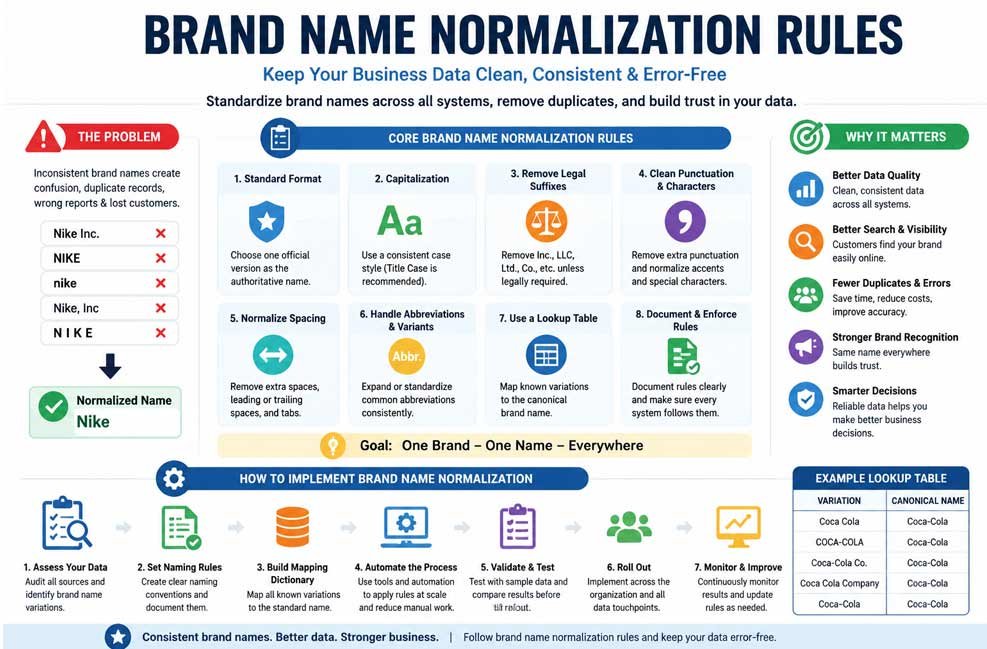
One common problem is capitalization. A brand may appear as “Nike,” “NIKE,” “nike,” or even “NiKe.” Although people know they represent the same company, many computer systems treat them as separate records until normalization rules fix them.
Punctuation creates another challenge. Some brands officially include special characters, while others do not. For example, “H&M,” “H & M,” and “H M” may all appear in different databases. If the rules are unclear, these records may never match correctly.
Extra spaces are another hidden problem. Leading spaces, trailing spaces, or multiple spaces between words often appear after importing information from different software. These tiny formatting issues can prevent proper matching even when the brand name is correct.
Legal business endings also create confusion. A company may appear as “Nike Inc.,” “Nike Ltd.,” “Nike LLC,” or simply “Nike.” Depending on the purpose of the data, businesses may choose to remove these legal suffixes or keep them in separate fields.
Brand names also change over time. Companies merge, launch new brands, or complete a rebranding project. Older names may continue appearing in older databases while new names appear elsewhere. Good normalization rules help connect these records without creating confusion.
Regional differences add another layer of difficulty. A global company may use different spellings, local languages, accented letters, or translated names in different countries. Businesses must decide how these names should connect while still respecting local branding.
User-generated content creates many errors as well. Customers often misspell brand names in search boxes, reviews, product uploads, and support forms. These typing mistakes create extra variations that must be cleaned before the data becomes reliable.
All these problems may look small individually, but together they can reduce reporting accuracy, increase duplicate records, confuse customers, and make daily business work much harder than it needs to be.
The Main Brand Name Normalization Steps
Building clean brand data follows a clear process. While every business has different systems, the basic steps remain almost the same. Following these steps helps apply brand name normalization rules correctly and consistently.
The first step is reviewing your data. Look through your CRM, product catalog, inventory system, supplier database, customer records, and marketing platforms. The goal is to find every place where brand names are stored and identify all the different versions being used.
Next comes identification. This means collecting every variation that represents the same brand. Differences may include spelling mistakes, abbreviations, punctuation changes, extra spaces, legal company endings, old brand names, or regional versions used in different countries.
After identification comes cleaning. Remove unnecessary spaces, fix obvious typing mistakes, standardize punctuation where appropriate, and correct formatting problems. However, be careful not to remove characters that are part of the official brand identity, such as the “&” in H&M or the number in 3M.
The standardization stage follows. Here, every accepted variation is mapped to one approved version. For example, “Coca Cola,” “COCA-COLA,” and “Coca-Cola” can all point to the official brand name “Coca-Cola.” This approved version becomes the single source of truth.
Once the names have been standardized, duplicate records should be found and merged. This process, known as deduplication, removes repeated entries that refer to the same brand. Instead of keeping several nearly identical records, the database stores one trusted version.
Good normalization also keeps the original value in a separate field whenever possible. This makes it easier to trace where the information came from and allows businesses to review or reverse changes if needed during future audits.
Finally, the process should be tested before being used across the entire organization. Running sample data through the normalization rules helps find incorrect matches early. Once everything works correctly, the same process can be added to data imports, forms, and daily workflows.
Core Brand Name Normalization Rules
Strong brand name normalization rules begin with choosing one official version of every brand. This approved name should usually match the brand’s official website, trademark, or legal documentation. Once selected, every system should use that same version consistently.
Capitalization should also follow one standard. If the official brand is written as “Nike,” then other versions like “NIKE” or “nike” should automatically become “Nike.” Using one style across all systems makes reports much cleaner and easier to read.
Another important rule is deciding how legal business endings will be handled. Many companies remove words such as “Inc.,” “Ltd.,” “LLC,” or “Corp.” when the goal is customer-facing reporting or product matching. However, these legal names may still be stored separately for contracts, tax records, or compliance purposes.
Punctuation should be handled carefully. Extra punctuation that does not change the brand’s identity can often be removed. However, official punctuation that is part of the brand itself should remain. The same applies to numbers, symbols, accents, and special characters that define the brand.
Normalization rules should also clean extra spaces, create consistent abbreviation policies, maintain a lookup table for known brand variations, and be fully documented so every employee and system follows exactly the same standards.
Brand Names and Legal Company Names
Many people think a brand name and a legal company name are always the same. In reality, they often have different purposes. A legal company name is the registered business name used for taxes, contracts, and government records. A brand name is the name customers see on products, websites, and advertisements.
For example, a company may own several brands. Customers may know only the product brand, while invoices and legal papers show the registered company name. Mixing these names together can create reporting problems and make business data less accurate.
This is why businesses should keep separate fields for legal company names, brand names, parent companies, and product brands. These records can be linked together, but they should not always replace one another.
Rebranding is another reason to separate these names. A business may change its public brand while keeping the same legal company name. Older records should still be connected so reports remain complete and easy to understand.
Mergers and acquisitions also create challenges. One company may buy another business but continue using the older brand because customers already know it. Good data management keeps these relationships clear without creating duplicate records.
How to Handle Special Brand Names
Some brand names include symbols, numbers, or special formatting that should not be removed. A good example is H&M. The “&” is part of the official brand name, so deleting it would change the brand’s identity.
Other brands such as 3M use numbers as part of their official name. These numbers should always remain because they help identify the brand correctly. Removing them would create incorrect records.
Some companies use special capitalization. A brand may officially use lowercase letters, uppercase letters, or a unique style. Your normalization rules should preserve the official appearance whenever possible instead of changing everything automatically.
Global businesses may also use accented letters or local spellings. For example, one country may use a translated brand name while another uses the original version. A lookup table can connect these names while still keeping the official local version.
Some businesses also work with non-English or non-Latin names. Modern systems should support these names instead of replacing them with simplified versions whenever possible. A separate search-friendly version can be stored if needed.
The goal is simple: remove unnecessary differences without removing the parts that make the brand unique.
How to Set Up Brand Name Normalization
The first step is reviewing all the places where brand names appear. This includes CRM software, product catalogs, supplier files, inventory systems, online stores, spreadsheets, and marketing platforms.
Next, create one clear naming guide. This document should explain how capitalization, punctuation, abbreviations, legal endings, spacing, and regional names should be handled. Every team should follow the same guide.
After that, build a mapping dictionary. This list connects common variations with the approved brand name. For example, “Coca Cola,” “COCA-COLA,” and “Coca-Cola” can all point to one official record.
Before using the rules everywhere, test them on a small group of records. Review the results carefully. If two unrelated brands are matched together, improve the rules before moving forward.
Once testing is complete, add normalization to every new data source. Online forms, file imports, APIs, and software integrations should all apply the same rules automatically. This prevents new errors from entering the database.
Finally, remember that normalization is not a one-time project. New brands, spelling mistakes, mergers, and rebranding happen regularly. Schedule routine reviews so your data stays clean over time.
Tools for Brand Name Normalization
Small businesses can often begin with spreadsheets and simple lookup tables. This works well when there are only a few hundred or a few thousand brand records to manage.
As data grows larger, automation becomes much more useful. Python libraries such as FuzzyWuzzy can help find names that look similar. However, fuzzy matching should only suggest possible matches. A similar name does not always mean it is the same brand.
Many large companies use Enterprise Master Data Management (MDM) platforms such as Talend or Informatica. These systems help manage brand names across many departments while supporting strong data governance.
Cloud services like Google Cloud Dataflow and AWS Glue can apply normalization rules while processing large amounts of business data. These tools work well for companies that receive information from many different systems every day.
Artificial intelligence can also help. AI tools can understand spelling mistakes, abbreviations, and different writing styles. They may even recognize related brand names that simple matching rules miss. Still, human review is important before making final decisions.
One helpful practice is using confidence scores. Exact matches can be accepted automatically, while uncertain matches can be reviewed by a person. This reduces mistakes and improves trust in the final data.
Choose tools based on your business size, budget, and data volume. The best solution is not always the most expensive one. A simple system that follows clear brand name normalization rules often performs very well.
Costly Brand Normalization Mistakes
One of the biggest mistakes is working without written rules. When every employee uses a different naming style, inconsistent records quickly spread across the business. A simple rulebook keeps everyone following the same standards.
Another common mistake is treating normalization as a one-time cleanup project. New records enter the system every day. Without ongoing checks, old problems quickly return.
Some businesses remove too much information. Converting every name to lowercase or deleting all punctuation may damage official names like H&M or 3M. Always protect the parts of a name that identify the brand.
Another mistake is mixing legal company names with customer-facing brand names. These names may be connected, but they should not always replace each other. Keeping separate fields makes reports much clearer.
Depending only on manual cleanup also causes problems. People become tired, overlook small details, and cannot review millions of records quickly. Automation should handle common cases while people review uncertain matches.
Many businesses delay deduplication until later. This often leaves several nearly identical records inside the database. Deduplication works best when it happens during the normalization process instead of after it.
Some companies also trust automation too much. Matching software may accidentally combine unrelated brands that have similar names. Always review uncertain matches before making permanent changes.
Finally, many organizations never measure results. Track duplicate rates, matching accuracy, review time, and data quality. These numbers show whether your normalization process is improving or needs adjustment.
Best Ways to Keep Brand Data Error-Free
The easiest way to keep clean data is by writing every normalization rule in one place. Keep the document updated whenever new brands, new systems, or new business needs appear.
Store both the original value and the normalized value. This creates a clear history and makes future reviews much easier. If a mistake happens, the original information is still available.
Use automation whenever possible. Apply normalization rules during data entry, file imports, website forms, and software connections. This prevents bad data from spreading across different systems.
Train employees as well. Marketing teams, sales staff, customer support, suppliers, and data managers should all understand why consistent brand names matter and how the rules work.
Keep a lookup table of known variations and update it regularly. Add new aliases, old brand names, regional versions, and common typing mistakes whenever they appear.
Review your data on a regular schedule. Monthly or quarterly audits help discover new problems before they become large. Continuous improvement is one of the most important parts of successful brand name normalization rules.
Finally, make normalization part of your overall data governance plan. When clean data becomes a daily habit instead of an occasional project, every department benefits.
Bottom Line
Keeping brand names consistent is one of the easiest ways to improve business data. Clear brand name normalization rules reduce errors, remove duplicates, improve reporting, and make daily work much easier. By combining simple standards, smart tools, regular reviews, and careful human oversight, businesses can build clean, reliable data that supports better decisions and stronger customer trust for years to come.
(FAQs)
What is the difference between a brand name and a legal company name?
A brand name is what customers see, while a legal company name is the registered business name used for legal, tax, and official purposes.
Can brand name normalization improve SEO?
Yes. Consistent brand names across websites, product pages, and online platforms help search engines better understand and recognize a brand, which can improve visibility.
Should legal endings like Inc. or LLC always be removed?
Not always. They may be removed for marketing or reporting purposes, but legal documents and compliance records often need the full registered company name.
Can AI help with brand name normalization?
AI can identify spelling mistakes, similar names, and common variations. However, uncertain matches should still be checked by people before records are merged.
How often should businesses review their normalization rules?
Businesses should review them regularly, especially after rebranding, mergers, new product launches, software updates, or major changes to their data sources.
Also Read: Image Search Techniques: Learn the Tricks Professionals Use Every Day

You may like

Nina Alu Biography: Everything You Need to Know About Iggy Pop’s Wife
Gamer Challenger: Best Strategies, Challenge Types, and Pro Tips for 2026
Who Is Clytie Lane? Everything to Know About Nick Nolte’s Wife
G Plus Games: Best Unblocked Browser Games for Quick Fun and Learning
What Is Olympus Scanlation? A Simple Guide for New Readers
Alexis Danson: Everything to Know About Ted Danson’s Daughter
Classroom 15X Review: Is It the Best Unblocked Gaming Platform?
Tech Giants Envision Future Beyond Smartphones
AnonVault Guide: Everything About Its Features, Security, and Benefits
Mickey Hargitay Jr. Biography: Everything to Know About Mickey Hargitay’s son
Revolutionizing Healthcare: The Emergence of AI-Driven Analytics
Carol Kirkwood’s Journey: Her Real Age, Husband, Career, and More
Body Positivity and Bodycon: Embrace Your Shape with Homecoming Dresses
Aliza Barber: Meet Lance Barber’s Wife, Age, Life, Profile, Career and Net Worth
How Machine Learning and AI are Redefining the Future?
Evelyn Melendez: Jordan Knight’s Wife Bio, Marriage, Family, Career and Net Worth
Ilan Tobianah Biography: Family, Marriage, Lifestyle, Career and Net Worth
Who was Alice Marrow? Everything to Know About Ice-T’s and His Mother
King Von’s Autopsy Report: The Truth Behind the Tragic Death
Tea Leoni and Tim Daly Split – A Closer Look at Their Relationship and Breakup
Nina Alu Biography: Everything You Need to Know About Iggy Pop’s Wife
Gamer Challenger: Best Strategies, Challenge Types, and Pro Tips for 2026
Who Is Clytie Lane? Everything to Know About Nick Nolte’s Wife
G Plus Games: Best Unblocked Browser Games for Quick Fun and Learning
What Is Olympus Scanlation? A Simple Guide for New Readers
Alexis Danson: Everything to Know About Ted Danson’s Daughter
Classroom 15X Review: Is It the Best Unblocked Gaming Platform?
Tech Giants Envision Future Beyond Smartphones
AnonVault Guide: Everything About Its Features, Security, and Benefits
Mickey Hargitay Jr. Biography: Everything to Know About Mickey Hargitay’s son
Category
Trending
-
Health3 years agoRevolutionizing Healthcare: The Emergence of AI-Driven Analytics
-
News11 months agoCarol Kirkwood’s Journey: Her Real Age, Husband, Career, and More
-
Fashion2 years agoBody Positivity and Bodycon: Embrace Your Shape with Homecoming Dresses
-
Celebrity2 years agoAliza Barber: Meet Lance Barber’s Wife, Age, Life, Profile, Career and Net Worth