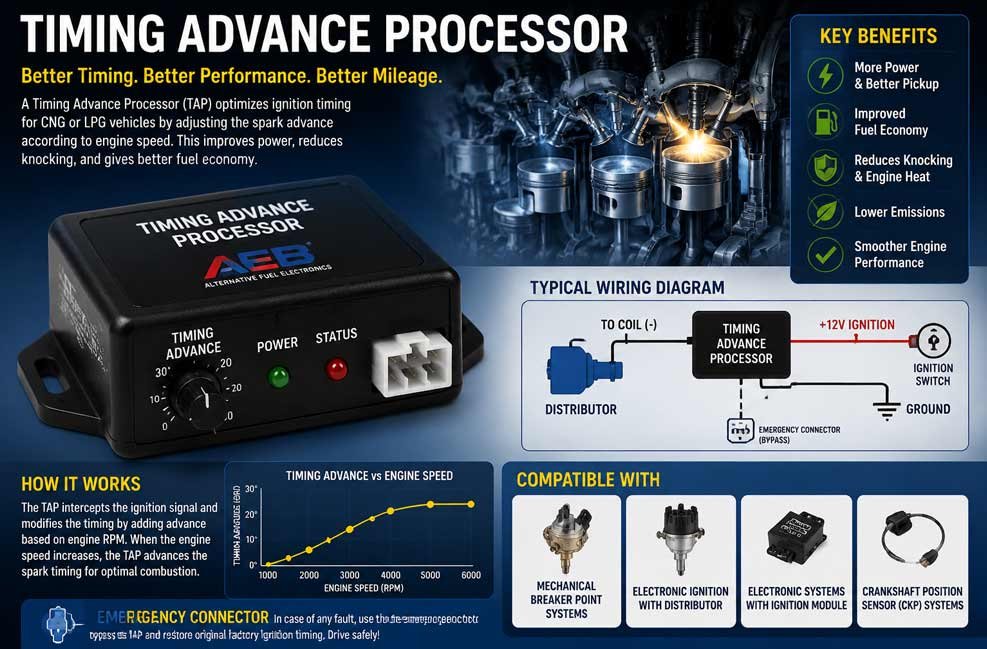
If your vehicle runs on CNG or LPG, you may have heard people talk about a timing advance processor. It may sound like a small part, but it plays a big role in how well your engine works. The right processor can help your engine run more smoothly, improve power, and even save fuel over time.
Many petrol engines are later converted to run on CNG or LPG because these fuels are often cleaner and more affordable. However, these fuels do not burn in exactly the same way as petrol. They burn more slowly, so the spark inside the engine must happen a little earlier. That is where a timing advance processor becomes useful.
Without the correct ignition timing, an engine may feel slow, lose power during acceleration, use more fuel, or even produce knocking sounds. A properly selected timing advance processor helps solve these problems by adjusting the spark timing to better match the fuel being used.
In this guide, you will learn what a timing advance processor is, how it works, why it matters for CNG and LPG vehicles, the different ignition systems it supports, the available processor types, and how to choose the best one for your engine. Everything is explained in simple words, whether you are a beginner, vehicle owner, or workshop technician.
What Is a Timing Advance Processor?
A timing advance processor, often called a TAP, is a small electronic device that changes the ignition timing of an engine. It is mainly used in vehicles that have been converted from petrol to CNG or LPG. Its job is to make sure the spark plug fires at the right time for these alternative fuels.
Petrol, CNG, and LPG do not burn at the same speed. Petrol burns faster, while CNG and LPG usually take a little longer to burn completely. Because of this difference, the spark needs to happen earlier when the engine is running on gas. The timing advance processor makes this adjustment automatically.
Instead of changing engine parts, the processor works with the ignition system. It receives the original timing signal, changes it by adding the correct amount of advance, and then sends the updated signal back to the ignition system. This allows the fuel to burn more completely inside the engine.
A timing advance processor also helps improve engine performance in several ways. It supports better acceleration, smoother driving, improved fuel economy, and lower exhaust emissions. It also reduces the chance of engine knocking, which can happen when ignition timing is not correct.
Many modern timing advance processors also include an emergency bypass connector. This safety feature lets the vehicle return to its original factory ignition timing if the processor develops a fault. The driver can continue using the vehicle until repairs are made, making the system safer and more reliable.
Why CNG and LPG Need Earlier Timing
To understand why a timing advance processor is needed, it helps to know how fuel burns inside an engine. Every engine depends on the spark plug to ignite the fuel-air mixture at exactly the right moment. Good timing creates smooth combustion and better engine performance.
Petrol burns fairly quickly after the spark occurs. Engine manufacturers set the factory ignition timing based on petrol because that is the fuel the vehicle was originally designed to use. When the engine continues running on petrol, the original timing usually works very well.
CNG burns more slowly than petrol. It also has a higher octane rating, which means it can handle earlier ignition without causing harmful knocking in most situations. Because combustion takes longer, the spark must happen a little sooner so the burning fuel reaches maximum pressure at the correct point inside the cylinder.
LPG also has different combustion characteristics. Although its behavior is closer to high-quality petrol than CNG, it still benefits from adjusted ignition timing. Proper timing helps LPG burn more completely, improving engine response and making the vehicle feel smoother during daily driving.
If the ignition timing is not changed after a fuel conversion, several problems may appear. The engine may lose power, accelerate slowly, use more fuel than expected, or produce knocking sounds. Some drivers also notice rough engine operation, especially under heavy load.
A timing advance processor helps prevent these problems by moving the spark to the proper position for CNG or LPG. The result is cleaner combustion, better throttle response, improved fuel efficiency, and a more enjoyable driving experience.
How a Timing Advance Processor Works
A timing advance processor works by changing the ignition signal before it reaches the ignition system. It does not create a new spark on its own. Instead, it carefully adjusts the timing of the original signal so the spark plug fires a little earlier when needed.
The processor connects between important parts of the ignition system. Depending on the vehicle, it may connect to the ignition module, distributor, or crankshaft position sensor. It reads the signal coming from these components, processes it, and then sends the corrected signal to the ignition system.
Many processors adjust timing based on engine operating conditions. Some provide a fixed amount of advance, while others allow installers to change the settings. Advanced programmable models can even create different timing curves for specific engines, fuel types, and driving conditions.
The amount of timing advance depends on the vehicle, engine design, and fuel being used. Some engines perform best with only a small adjustment, while others need a greater timing advance to achieve the best results. This is why choosing the correct processor and setting it properly is so important.
Most timing advance processors include simple adjustment methods. Depending on the model, installers may use small switches, a control knob, or programming software to change the timing settings. Manufacturers usually provide recommended starting values, which are then fine-tuned after testing the engine.
One valuable safety feature found in many AEB timing advance processors is the emergency bypass connector. If the processor fails or needs to be removed during troubleshooting, the connector restores the original ignition signal. This allows the vehicle to run using factory timing until the issue is fixed.
Main Types of Ignition Systems
Before choosing a timing advance processor, you must first know which ignition system your vehicle uses. This is one of the most important steps because different ignition systems produce different types of signals. A processor designed for one system may not work correctly with another.
Older vehicles often use a mechanical breaker point ignition system. These systems rely on mechanical contact points and a distributor to control the spark. Because their electrical design is simple, they require processors that are specially made for breaker point ignition systems.
Many vehicles built after mechanical systems use electronic ignition with a distributor. Instead of breaker points, these systems use electronic switching to control ignition. The distributor is still present, but timing signals are handled electronically, allowing smoother operation and better reliability.
Some engines use electronic ignition modules that manage ignition timing using information from engine speed and load. These systems are more advanced and often support programmable timing advance processors that allow installers to adjust timing curves for different engines and fuel types.
Most modern vehicles use a crankshaft position sensor (CKP) instead of a traditional distributor. This sensor tells the engine exactly where the crankshaft is, allowing the ignition system to fire the spark with excellent accuracy. Timing advance processors for CKP systems must work with digital sensor signals.
There are two common CKP sensor designs. Inductive sensors create an analog voltage signal as the crankshaft rotates, while Hall effect sensors create a digital square-wave signal using changes in a magnetic field. Since these signals are different, each sensor type requires a compatible timing advance processor.
Types of Timing Advance Processors
Timing advance processors are available in several versions because not every engine uses the same ignition system. Choosing the correct type is just as important as installing it properly. A compatible processor gives better performance and avoids signal problems.
For older vehicles with mechanical breaker point ignition, processors like the AEB531 are commonly used. These units connect between the distributor and the ignition coil. They are designed to work with simple low-voltage ignition signals and support both CNG and LPG fuel systems.
Vehicles with electronic ignition and a distributor often use models such as the AEB526N and AEB549N. These processors connect to the ignition module output signal and are designed to respond quickly to electronic ignition systems while providing stable spark timing.
More advanced electronic ignition module systems can use the AEB515N. This programmable model allows installers to adjust timing curves for different engines and driving conditions. It offers greater flexibility, making it suitable for vehicles that require more precise tuning.
Modern vehicles equipped with crankshaft position sensors use different processor models depending on the sensor type. AEB510N and AEB516N are designed for inductive CKP sensors, while AEB511N and AEB518N are made for Hall effect CKP sensors. These processors carefully handle digital timing signals while maintaining accurate ignition control.
How to Choose the Right Timing Advance Processor
Choosing the right timing advance processor starts with understanding your vehicle. The processor must match your ignition system, engine type, and fuel system. Buying the wrong model can cause poor engine performance or prevent the system from working correctly.
The first thing to check is your ignition system. Older vehicles may have mechanical breaker points, while newer ones may use an electronic distributor, an ignition module, or a crankshaft position sensor. Every system sends different signals, so the processor must be designed to handle them.
Next, check which fuel your vehicle uses. Some processors work with both CNG and LPG, while others are designed for only one fuel system. If your vehicle switches between petrol and gas, choose a model that supports dual-fuel operation.
The timing adjustment range also matters. Different engines need different amounts of ignition advance. Some processors allow only basic adjustment, while others offer programmable timing curves. If your engine has special tuning needs, a programmable model gives greater control.
It is also smart to choose a processor with an emergency bypass connector. This feature lets you return to the factory ignition system if the processor develops a fault. It adds safety and makes troubleshooting much easier.
Finally, check wiring connectors, sensor compatibility, and the manufacturer’s application list before buying. If you are unsure, ask an experienced CNG or LPG installer. A little extra checking can prevent expensive mistakes later.
Popular AEB Timing Advance Processor Models
AEB is one of the best-known companies that makes timing advance processors for alternative fuel vehicles. Their products are widely used because they support many different ignition systems and include safety features like emergency bypass connectors.
The AEB531 is designed for mechanical breaker point ignition systems. It connects between the distributor and the ignition coil and supports both CNG and LPG. Its timing adjustment range is usually between 0 and 25 degrees, making it suitable for many older vehicles.
For electronic ignition systems with a distributor, AEB526N and AEB549N are common choices. These models connect to the ignition module output and normally provide an adjustment range of up to 20 degrees. They work well with many converted petrol engines.
Vehicles with advanced ignition modules often use the AEB515N. This processor is programmable, allowing installers to create custom timing settings for different engines and fuel types. It is a flexible option for workshops that handle many vehicle models.
Modern engines with crankshaft position sensors need different processors depending on the sensor type. AEB510N and AEB516N support inductive sensors, while AEB511N and AEB518N work with Hall effect sensors. These models usually provide timing adjustment up to 30 degrees and support both CNG and LPG.
Although these AEB models look similar, each one is made for a specific ignition system. Always match the processor to the correct sensor and wiring type before installation.
Timing Advance Processor Installation
Installing a timing advance processor is not difficult, but every connection must be correct. Careful installation helps the engine run safely and avoids future problems.
Before starting, disconnect the battery. This protects the vehicle’s electrical system and reduces the chance of short circuits while working with the ignition wiring.
Next, identify the correct wires by using the manufacturer’s wiring diagram. Depending on the vehicle, you may connect the processor to the distributor, ignition module, or crankshaft position sensor. Every wire must be connected to the correct terminal.
If the vehicle has a mechanical ignition system, the processor normally connects between the distributor’s negative terminal and the ignition coil’s negative terminal. Good grounding is also important because poor grounding can affect ignition signals.
For electronic ignition systems, connect the processor to the ignition module output signal. Make sure both the power supply and ground wires are connected securely. Loose connections can lead to poor engine performance or failure to start.
Vehicles with crankshaft position sensors require extra care. The processor must be installed inline with the sensor signal while keeping the correct signal direction and shielding. Reversed wiring or damaged shielding may create signal problems.
Mount the processor in a cool, dry place away from engine heat, water, and moving parts. Secure the wiring properly so it cannot rub against sharp edges or become damaged over time.
After installation, reconnect the battery and start the engine. Check idle speed, acceleration, and general engine operation before taking the vehicle for a road test.
How to Set the Correct Timing Advance
After installation, the processor needs proper adjustment. Even the best timing advance processor cannot perform well if its settings are incorrect.
Most manufacturers recommend starting with a timing advance of around 10 to 15 degrees for many CNG conversions. This is only a starting point. The final setting depends on the engine, fuel type, and driving conditions.
Some processors use small adjustment knobs or DIP switches. Others, especially programmable models like the AEB515N, use software to create custom timing curves.
A timing light is useful for checking ignition timing on many ignition systems. It helps confirm that the actual spark timing matches the selected settings.
For crankshaft sensor systems, workshops often use an oscilloscope. This tool checks that the sensor signal remains clean and stable after the processor has been installed.
Once the timing has been adjusted, test the vehicle at idle, during normal driving, and at higher engine speeds. Listen for engine knocking, poor acceleration, or rough running. Small adjustments may improve performance even more.
Remember that adding too much timing advance can reduce performance just as much as too little advance. Careful tuning always gives the best results.
Common Problems and Easy Fixes
Like any electronic device, a timing advance processor can sometimes develop problems. Most issues are easy to diagnose if you know what to look for.
If the engine knocks while running on CNG or LPG, the ignition timing may not be advanced enough. Increasing the timing slightly often solves the problem, but adjustments should always be made carefully.
Poor acceleration can sometimes mean the opposite. Too much ignition advance may cause the engine to lose power instead of gaining it. Reducing the timing a little may restore smooth performance.
If the engine refuses to start after installation, inspect every wiring connection. Incorrect wire placement, poor grounding, or loose connectors are among the most common installation mistakes.
A rough idle may indicate incorrect idle timing settings or an installation problem. Recheck the processor settings and inspect the wiring before making further adjustments.
If the processor appears to have stopped working, first verify the 12-volt power supply and ground connection. Many problems are caused by simple electrical issues rather than a faulty processor.
The emergency bypass connector is very helpful during troubleshooting. By connecting it, the processor is removed from the ignition circuit, allowing the engine to return to factory timing. If the engine runs normally after bypassing the unit, the processor or its settings should be checked.
Bottom Line
A timing advance processor is a valuable upgrade for many CNG and LPG vehicles because it adjusts ignition timing to match the slower-burning fuel. When the correct model is chosen and installed properly, it can improve engine power, fuel economy, throttle response, and overall driving comfort while helping reduce knocking and emissions.
The key is to identify your vehicle’s ignition system first, choose a compatible processor, follow the correct installation steps, and adjust the timing carefully. Whether you drive an older vehicle with a distributor or a modern engine with a crankshaft position sensor, selecting the right timing advance processor will help your alternative fuel system perform at its best.
(FAQs)
Can a timing advance processor improve fuel economy?
Correct ignition timing helps the engine burn fuel more completely, which can improve fuel economy and reduce wasted fuel.
How do I know which timing advance processor is right for my vehicle?
Check your vehicle’s ignition system, crankshaft sensor type, engine model, and fuel system. Always choose a processor that matches these specifications.
What is the emergency bypass connector used for?
The emergency bypass connector allows the vehicle to return to its original factory ignition timing if the processor fails or needs to be removed for testing.
Can I install a timing advance processor myself?
Basic installations may be possible for experienced users, but modern electronic vehicles often require professional installation and testing for the best results.
Does a timing advance processor need regular maintenance?
The processor itself usually needs very little maintenance, but checking wiring, connections, and timing settings during routine service helps keep the system working correctly.
Also Read: Application Client Container in 2026: Everything Developers Should Know