Introduction
In today’s highly competitive market, spanning from aerospace to medical technology, the demand for precision in metal and plastic components has escalated to unprecedented levels, with tolerances as tight as ±0.005mm becoming the benchmark for many advanced applications. However, a core problem persists: not all suppliers claiming to offer Precision CNC Machining Services possess the equivalent technical prowess and quality control systems to achieve this stability consistently, leading clients to face risks of inconsistent quality and project delays.
This article aims to provide a clear framework, detailing how to evaluate a supplier’s technical documentation, equipment capabilities, metrology, and quality management systems when selecting a partner. To ensure your next project meets its precision expectations, the following critical considerations are indispensable.
What Truly Defines High Precision? How is Precision CNC Machining Service Beyond Standard Tolerances Defined?
The Multifaceted Nature of Precision
In the context of high precision CNC machining, “high precision” transcends a single tolerance number like ±0.005mm. It represents a comprehensive concept that encompasses dimensional stability over time, specified surface finish (e.g., Ra values), and meticulous control over geometric dimensioning and tolerancing (GD&T), which governs the form, profile, orientation, and location of features. A component must not only be manufactured to the correct size but must also maintain its dimensions under varying conditions, exhibit the required surface texture for its function, and adhere to strict geometric relationships.
The Foundational Prerequisites for Achieving High Precision
Achieving and reliably reproducing such precision demands a controlled ecosystem built on several technical pillars. It is not achievable with standard machine tools or in an uncontrolled environment.
l The Role of Advanced Machinery and Environmental Control
Key prerequisites include high-rigidity machine tools that resist deflection under cutting forces and sophisticated thermal stability controls to compensate for heat-induced expansion. Furthermore, stringent environmental controls within the workshop, managing temperature and humidity fluctuations, are critical to minimizing external influences on machining accuracy. The very definition of precision is rooted in metrology, the science of measurement. Authoritative bodies like Germany’s Physikalisch Technische Bundesanstalt (PTB) establish and maintain the standards that make such precision possible and verifiable, underscoring the scientific seriousness behind these definitions.
l The Criticality of Specialized Tooling and Expertise
The selection and application of advanced CNC machining tools—from micro-grain carbide end mills to diamond-tipped tools—are paramount for fine detailing and superior surface finishes. However, the tools alone are insufficient; the expertise in selecting the correct tool, speeds, and feeds for a specific material and geometry is what separates a true precision manufacturer from a basic machine shop. This deep process knowledge is a cornerstone of professional Precision CNC Machining Services.
How to Identify a Truly Capable Precision CNC Machining Service Provider Through Their Technical Equipment List ?
H3: Decoding the Machine Tool Inventory
A supplier’s capability is materially defined by its equipment portfolio. Prospective clients should scrutinize key machine indicators, such as the presence of multi-axis CNC systems (e.g., 5-axis machining centers), high-performance spindles that maintain rotational accuracy at high speeds, and precision tool holder systems (like HSK or hydraulic chucks) that minimize runout. The integration of real-time compensation technologies that proactively adjust for tool wear and thermal drift is also a mark of an advanced facility.
The Impact of Advanced Technology on Capability
Multi-axis machining is particularly crucial for complex components. A 5-axis machine allows for completing a part in a single setup, significantly reducing the cumulative errors associated with repositioning a part across multiple machines. This capability not only enhances accuracy but also enables the production of highly complex shapes. The combination of these advanced CNC machining tools and technologies is fundamental to machining complex geometries and maintaining long-term precision stability, which is a hallmark of a top-tier precision CNC machining services provider. A deep understanding of tooling is essential for professionalism. For example, knowledge of specific tools like reamers is critical for achieving precise hole tolerances and fine surface finishes. A provider’s expertise in selecting and applying the right tools is a key aspect of professional precision CNC machining services.
Beyond Quality Certifications: The Intricacies of a Precision CNC Machining Service Provider’s Measurement and Verification System
Metrology: The Ultimate Judge of Quality
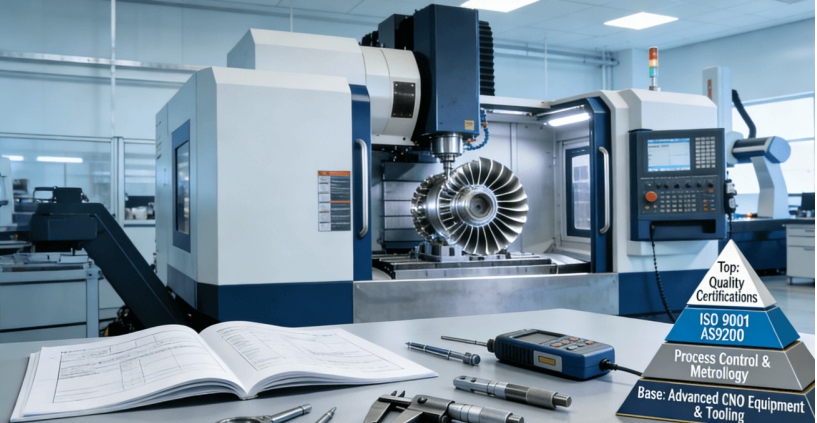
While certifications like AS9100D and ISO 9001 provide a foundational framework for a quality management system, they are merely the entry point. The true measure of a CNC machining manufacturer‘s capability lies in its measurement capacity and the effectiveness of its measurement procedures. It is essential to evaluate the technology available in their metrology lab, such as Coordinate Measuring Machines (CMM), laser scanners, and optical comparators, and, more importantly, how they are used.
Evaluating Measurement System Effectiveness
Merely possessing a CMM is insufficient. A mature quality control system employs tools like Measurement System Analysis (MSA) to quantify the statistical uncertainty of its measurements, ensuring that the data collected from inspections is reliable and can be used to make confident decisions about part conformity. Furthermore, suppliers should provide detailed inspection reports that include actual measured values, not just pass/fail checkmarks, and demonstrate statistical process control (SPC) to prove consistent capability over time. A manufacturer like JS Precision typically invests in state-of-the-art metrology laboratories to ensure data objectivity and uphold the highest standards of verification.
From Rapid Prototyping to Batch Production: How Does Precision CNC Machining Service Ensure End-to-End Consistency?
Seamless Process Integration
An exceptional Precision CNC Machining Services provider offers seamless integration from Rapid prototyping to small and medium-volume batch production. This requires a robust system of standardized processes, rigorous tool management, and in-process controls. The objective is to ensure that the first prototype part is functionally and dimensionally identical to the hundredth production part, guaranteeing reliability throughout the product lifecycle.
Mechanisms for Ensuring Consistency
Consistency is achieved through meticulous process engineering. This includes creating standardized setup sheets, implementing preventive maintenance schedules for machines, and using tool presetters to accurately define tool geometry offline. In-process controls, such as first-article inspections and periodic in-process audits using statistical methods, are vital for catching deviations early. This end-to-end consistency is paramount in fields like medical device manufacturing and aerospace components, where a single part failure can have severe consequences. The ability to scale from prototype to production without sacrificing precision is what distinguishes advanced custom CNC machining services.
What are the Most Overlooked Hidden Costs When Selecting a Precision CNC Machining Service Provider?
The Illusion of the Lowest Unit Price
A common pitfall when selecting a Precision CNC Machining Services provider is focusing exclusively on the unit price per part. The true CNC machining cost extends far beyond this initial figure and encompasses the Total Cost of Ownership (TCO). TCO includes often-overlooked expenses such as those arising from quality failures, project delays, and inefficiencies in communication and project management. An apparently low quote can quickly become expensive if it leads to rejected batches, missed product launch deadlines, and significant internal resources being spent on problem-solving.
A Detailed Breakdown of Hidden Costs
To make an informed decision, it is crucial to understand the categories where hidden costs can accumulate. A thorough evaluation of these areas reveals the true value proposition of a supplier.
l Costs of Poor Quality: Rework, Scrap, and Failure
These are the most direct and tangible hidden costs. They include the expenses associated with sorting defective parts, the material and machine time lost to scrap, the labor required for rework, and, in worst-case scenarios, liabilities stemming from field failures. A supplier lacking robust process controls and a mature quality management system may offer a lower initial price but carries a much higher risk of generating these costly failures, which can negate any upfront savings and damage the client’s reputation.
l Costs of Delay and Miscommunication
Project delays have tangible financial impacts, such as missed market opportunities, delayed revenue streams, and contractual penalties. A supplier with immature production planning, unreliable equipment leading to frequent breakdowns, or poor quality causing batch rejections inevitably leads to delays. Furthermore, costs from miscommunication, such as time spent clarifying requirements or correcting misunderstandings due to a lack of technical support, add significant management overhead that is rarely reflected in the unit price.
The Value of Partnership and “First-Time-Right” Manufacturing
Selecting a premium Precision CNC Machining Services partner is an investment in risk mitigation. Their initial quote, while potentially higher, reflects the systemic investment in advanced equipment, skilled personnel, and thorough quality protocols designed to ensure “first-time-right” production. This philosophy minimizes the hidden costs listed above, protects the client’s brand reputation, and ensures project timelines are met reliably. For any Custom Parts Production endeavor, conducting thorough due diligence on a supplier’s end-to-end capabilities is the most effective way to control the true total cost and achieve a successful partnership.
Conclusion
Selecting a qualified Precision CNC Machining Services provider is a highly technical decision. It requires a systematic evaluation of precision definitions, technical equipment, quality verification, process control, and total cost, rather than a simplistic comparison of numbers on a quotation. When searching for a partner for your next high-demand project, it is advisable to use the framework provided in this article to pose deeper technical inquiries to potential suppliers, ensuring your investment yields precision components and quality assurance as expected.
Author Biography
This article was authored by an industry expert with extensive experience in the precision manufacturing sector, whose professional background encompasses the application of high-precision CNC machining technologies and quality management in aerospace and medical device industries.
FAQs
Q1: What is the typical tolerance range for Precision CNC Machining Services?
A: For metals like aluminum and steel, excellent Precision CNC Machining Services can consistently hold tolerances from ±0.025mm down to ±0.005mm, depending on part size, geometry, and material characteristics.
Q2: Is 5-axis CNC machining essential for improving precision?
A: Yes. 5-axis machining reduces workpiece setup times, significantly lowering cumulative errors. It also allows for the use of shorter cutting tools, which increases machining stability and improves surface quality, making it key for complex, high-precision parts.
Q3: How to evaluate if a quote for Precision CNC Machining Services is reasonable?
A: The quote should be scrutinized to see if it includes complete process planning, detailed inspection reports, material certifications, and adherence to industry standards. An unusually low quote may indicate compromises in critical processes or quality control.
Q4: In precision machining, do common surface treatments affect final dimensional accuracy?
A: Yes. Processes like plating or anodizing add a coating layer, which can alter final dimensions. Therefore, the tolerances on the drawing should clearly specify whether they apply to the post-machined state or post-surface-treatment state, and this must be thoroughly communicated with the supplier.
Q5: What is the most important consideration for small-batch, high-precision Custom Parts Production?
A: It is the supplier’s process development capability and flexibility. Small-batch production tests the ability to quickly optimize processes and setups rather than the efficiency of mass production, therefore choosing a specialist focused on such services is more important.