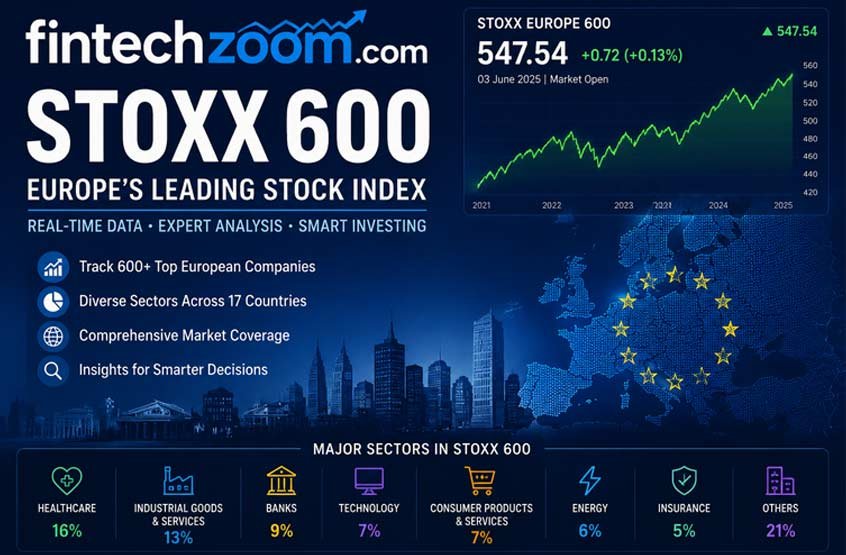
Europe is home to many of the world’s best-known businesses. These companies make medicines, food, cars, computer chips, clothes, machines, banking services, and energy products. Yet following hundreds of European stocks one by one can be difficult. This is why broad market indexes are useful.
The STOXX Europe 600 gives investors a simple view of the wider European share market. It follows 600 large, medium, and smaller companies from developed European countries. Together, these companies cover a large part of the region’s listed market and many parts of its economy.
People searching for fintechzoom.com stoxx 600 are often trying to understand the index, check recent market moves, study major sectors, or learn how European index funds work. FintechZoom publishes financial news, stock information, charts, market views, and other content that may help readers follow these topics.
Still, a market website should be used as one source among several. Index facts, company lists, ETF fees, and market values can change. Important details should also be checked through the official STOXX website, regulated fund providers, trusted brokers, and reliable financial news sources.
This guide explains what the STOXX Europe 600 is, how it works, which countries and sectors it covers, and which major companies affect it. The second half will look at past performance, market forces, investment choices, benefits, risks, and the outlook for the index.
What Is the STOXX Europe 600?
The STOXX Europe 600 is a major European share index. Its official name is the STOXX Europe 600 Index, and it is often shortened to the STOXX 600. It contains a fixed number of 600 companies from developed European markets. STOXX describes it as a broad measure of European share performance.
An index is not a company or a fund. It is a list and a set of rules used to measure a group of shares. When the combined value of its member companies rises, the index usually rises. When many important members fall, the index may also move lower.
The index includes large-cap, mid-cap, and small-cap companies. A large-cap company has a high market value, while a small-cap company has a lower value. Including different company sizes gives the STOXX 600 wider coverage than an index that follows only a few giant businesses.
The STOXX Europe 600 was introduced in 1998. Since then, it has become an important benchmark for fund managers, banks, traders, researchers, and everyday investors. They use it to judge how European shares are doing and to compare the results of investment funds.
The index covers companies from 17 developed European markets. These include major financial centres such as the United Kingdom, France, Germany, Switzerland, and the Netherlands. It also contains businesses from countries such as Spain, Italy, Sweden, Denmark, Belgium, Finland, Ireland, Norway, Austria, and Portugal.
One important point is that the STOXX 600 is not limited to the European Union. The United Kingdom, Switzerland, and Norway are not EU members, but companies from these countries can still be included. The index is based on developed European share markets, not only EU membership.
The index represents roughly 90% of the free-float market value of its wider European investment area. In simple words, it covers most of the shares that are available for public trading. This gives investors a broad picture of Europe’s listed business market rather than a narrow view of one country.
It is also different from the EURO STOXX 50. The EURO STOXX 50 follows 50 large companies from countries that use the euro. The STOXX Europe 600 is much wider. It includes 600 companies, several company sizes, and markets that do not use the euro.
How the STOXX 600 Works
The STOXX 600 does not choose companies because they are famous. It follows clear index rules. Eligible European shares are ranked mainly by their free-float market value. The index then selects companies needed to keep the number of members at 600.
A company’s market value is found by multiplying its share price by the number of shares it has issued. Free-float market value uses only the shares that ordinary investors can trade. Shares held closely by founders, governments, families, or controlling owners may not be fully counted.
Imagine that a company has one billion shares, but its founding family controls 400 million of them and rarely trades them. The index may focus more on the remaining 600 million shares that are available in the public market. This gives a clearer view of the stock that investors can actually buy.
The STOXX 600 is weighted by free-float market value. This means bigger listed companies usually have more power over the index than smaller ones. A large move in a major company such as ASML, SAP, Roche, or Nestlé may affect the index more than the same move in a small member.
However, one company does not control the whole index. The 600-member structure spreads weight across many businesses, sectors, and countries. This is one reason the STOXX 600 is often used as a broad European benchmark instead of a guide to only a few large names.
The index is reviewed every three months. During each review, STOXX checks company size, eligibility, trading access, and other rule-based factors. Companies that have grown may enter, while companies that have fallen below the needed level may leave. The March 2026 changes, for example, became active on March 23, 2026.
These reviews help the index stay close to the real market. Europe’s biggest listed firms do not remain the same forever. A fast-growing business may gain weight, while a company facing falling sales, a lower share price, or a major business change may lose weight.
The index level also changes during each trading day. Share prices move after earnings reports, economic news, interest-rate decisions, political events, and changes in investor mood. Because European exchanges do not all use the same currency, index calculations also need clear currency and pricing rules.
Readers should also know the difference between a price index and a total-return index. A price index mainly follows changes in share prices. A total-return version also counts dividends paid by member companies. This difference can become large when results are measured over many years.
Dividends are important in European markets because many banks, insurers, energy firms, healthcare groups, and consumer companies return part of their profits to shareholders. A chart showing only price growth may therefore tell only part of the long-term return story.
What FintechZoom Shows Investors
FintechZoom is a financial content website. It covers areas such as stock markets, banking, financial technology, digital assets, economic news, and market trends. Its STOXX 600 pages may include index information, charts, technical views, market reports, and details about European stocks.
The phrase fintechzoom.com stoxx 600 does not refer to a separate stock index. The actual index is created and managed by STOXX. FintechZoom is one of the websites that discusses or displays information connected with it. Keeping this difference clear helps readers avoid confusion.
A reader may use FintechZoom to get a quick view of market direction. For example, the site may show whether European shares are rising or falling, which sectors are active, or which business stories are affecting investor mood. This can provide a useful starting point for more research.
Charts can help readers see price movements over different periods. A one-day chart shows short market moves, while a one-year or five-year chart gives more context. Changing the time range can stop readers from making a big decision based only on one unusual trading session.
Sector news is also useful. The STOXX 600 can rise even when several member companies fall. This may happen when a heavily weighted sector performs well. In July 2026, for example, weakness in European technology shares placed pressure on the wider index, while energy shares gained as oil supply worries grew.
Company news can explain these moves in more detail. Sales growth, profit warnings, new products, legal problems, job cuts, mergers, and changes in company guidance can all affect share prices. A strong result from a large member may lift its sector and support the wider index.
FintechZoom may also publish market opinions and technical analysis. Technical analysis studies past price moves, chart patterns, and trading activity. It may help some traders plan entry or exit levels, but it cannot tell the future with certainty. Charts should not replace checks on company health and wider economic facts.
Readers may also find older reports, market snapshots, and historical discussions. These can help explain how European shares reacted to past events. However, the date of each page matters. An article from 2022 or 2023 may still be useful for history, but its prices, members, forecasts, and ETF details may no longer be current.
Some third-party articles claim that FintechZoom offers full downloadable STOXX 600 reports, live tools, expert forecasts, and detailed sector data. Readers should check what is truly available on the website at the time of use. Features can change, and not every page provides the same tools.
The safest method is to compare information. Readers can use FintechZoom for general market coverage, the official STOXX site for index rules and members, ETF providers for fund facts, and trusted news outlets for current events. No single website should be the only base for an investment choice.
FintechZoom also states that it does not support a specific investment product and is not responsible for investment losses. This is an important reminder. Financial content can help people learn, but it does not know a reader’s income, goals, debts, time plan, or comfort with risk.
Countries Inside the STOXX 600
The STOXX Europe 600 brings several European markets into one index. This matters because Europe is not one single stock market. Each country has its own exchanges, major industries, local rules, taxes, currency needs, and economic strengths.
The United Kingdom has long been an important part of the index. Its market includes global banks, mining groups, oil companies, medicine makers, insurers, and consumer brands. Many of these businesses earn money around the world, so their results may depend on global growth as much as the British economy.
France is strong in luxury goods, banking, energy, industrial work, healthcare, and consumer products. Large French companies often sell across Asia, North America, and other parts of Europe. This means changes in global demand can have a strong effect on their sales and share prices.
Germany is known for industrial groups, software, chemicals, cars, engineering, and financial services. German companies can be sensitive to factory orders, energy costs, exports, and trade with major world markets. Weak global demand can hurt them, while stronger industrial spending can provide support.
Switzerland plays a major role even though it is not part of the European Union. Its market contains large healthcare, food, insurance, banking, and industrial companies. Firms such as Roche, Novartis, and Nestlé can carry meaningful weight because of their large public market values.
The Netherlands has become especially important through large chip and technology businesses. ASML is a clear example. It makes highly advanced machines used in chip production. Because the company is large, news about chip demand, export rules, and artificial intelligence spending can affect the wider European index.
Denmark has gained attention through healthcare and medicine companies, while Sweden offers strong industrial, engineering, banking, and communication firms. Spain and Italy add major banks, utilities, energy businesses, transport groups, and infrastructure companies. Smaller markets add even more variety.
Country weights are not equal. A market with many large listed companies usually receives more weight than a market with fewer or smaller firms. These weights can change as share prices rise and fall, companies enter or leave, and free-float share numbers change.
Country spread can lower the harm caused by trouble in one market, but it cannot remove regional risk. A recession, energy shock, war, banking problem, or major policy change may affect several European countries at the same time.
Currency is another key point. STOXX 600 companies trade in currencies such as the euro, British pound, Swiss franc, Danish krone, Swedish krona, and Norwegian krone. Changes in these currencies can affect company earnings, index values, and the final return received by an overseas investor.
Main Sectors in the STOXX 600
One of the biggest strengths of the STOXX 600 is its sector mix. The index does not depend only on banks, technology firms, or energy companies. It spreads its members across healthcare, industry, finance, consumer goods, food, technology, insurance, utilities, energy, property, media, and other business areas.
The exact weight of each sector changes with share prices and index reviews. This is why fixed percentages from an older article should be treated as a past snapshot, not a permanent rule. A sector can gain weight when its largest companies rise faster than the rest of the market.
Healthcare has often been one of the index’s major areas. It includes medicine makers, medical equipment firms, research groups, and other health businesses. Large companies such as Roche, Novartis, Novo Nordisk, AstraZeneca, and Sanofi can give the sector a strong place within the index.
Healthcare firms may offer some balance during weak economic periods because people still need medicines and care. Yet they are not free from risk. Drug trial results, patent endings, price rules, safety issues, competition, and government decisions can quickly change a company’s outlook.
Industrial goods and services also form a large part of the STOXX 600. This area includes factory tools, electrical systems, transport equipment, defence products, building systems, and engineering services. Siemens, Schneider Electric, ABB, Airbus, and Atlas Copco are well-known examples.
Industrial shares often respond to business spending and economic growth. They may do well when companies build factories, improve power networks, buy machines, or spend on transport and defence. They may struggle when orders slow, borrowing costs rise, or supply problems delay work.
Banks and other financial firms are another important group. HSBC, BNP Paribas, Santander, Deutsche Bank, UBS, and other banks can be affected by interest rates, loan demand, bad debts, market trading, and economic confidence. Higher rates may help some income areas but can also raise repayment problems.
Insurance companies such as Allianz, AXA, Zurich Insurance, and Prudential add another form of financial exposure. Their results may depend on premium income, claims, weather events, investment returns, and long-term interest rates. They do not always move in the same way as banks.
Consumer products and food companies include many names used in daily life. Nestlé, Unilever, L’Oréal, Danone, Reckitt, and Anheuser-Busch InBev sell food, drinks, beauty items, and household goods. Their strong brands may support steady sales, although rising costs can reduce profits.
Technology has often had a smaller index share than it has in the U.S. S&P 500, but its role has grown. ASML, SAP, Infineon, and other European technology firms connect the index with chip demand, cloud software, automation, digital services, and artificial intelligence spending.
Technology can move quickly in both directions. In 2024, strong chip demand and interest in artificial intelligence helped European technology shares reach high levels, with ASML and SAP among the firms supporting the sector.
Energy members include large oil, gas, and power companies such as Shell, TotalEnergies, Eni, and Equinor. Their shares often react to oil and gas prices, production levels, world demand, political events, and the move toward cleaner energy.
Utilities, construction, materials, property, media, basic resources, travel, and communication firms complete the wider mix. Each area reacts to different forces. For example, utilities may be sensitive to power rules and interest rates, while mining shares may move with metal prices and Chinese demand.
This sector spread helps explain why the STOXX 600 may act differently from the S&P 500 or Nasdaq. The European index has more weight in areas such as healthcare, industry, finance, energy, and consumer brands, while major U.S. indexes often have much heavier exposure to technology.
Major Companies in the Index
The STOXX 600 contains hundreds of businesses, but its largest members receive the most attention. Because the index is weighted by free-float market value, a very large company can have a much greater effect than a smaller member.
ASML is one of Europe’s most important technology companies. Based in the Netherlands, it makes special machines used by chip factories. These machines help produce the advanced chips used in phones, computers, cars, data centres, and artificial intelligence systems.
ASML’s share price can react to chip spending, orders from large customers, supply limits, and rules on selling advanced machines to some countries. Its large market size means a sharp rise or fall may affect both the technology sector and the wider STOXX 600.
SAP is another major European technology name. The German company sells business software used for finance, staff records, supply chains, customer services, and other daily work. Its move toward cloud-based services has made subscription growth and cloud sales important points for investors.
Europe also has several large healthcare companies. Roche and Novartis are major Swiss medicine groups. AstraZeneca and GSK are key British healthcare names, while Sanofi is based in France. Their share prices can move after drug approvals, trial results, new research, patent news, and sales reports.
Novo Nordisk became one of Europe’s most closely followed companies because of strong demand for diabetes and weight-loss medicines. Its growth has also shown how one successful product area can greatly increase a company’s market value and its effect on national and European indexes.
Nestlé is one of the world’s largest food and drink companies. Its products are sold in many countries, so its results can be affected by global consumer demand, ingredient costs, currency moves, pricing decisions, and changes in buying habits.
Unilever is another widely known consumer group. It sells personal care, home care, food, and other daily products. L’Oréal adds strong exposure to beauty and personal care, while companies such as Danone and Reckitt cover food, health, and household needs.
The industrial side includes Siemens, Schneider Electric, ABB, Airbus, and Atlas Copco. These companies are linked with factory equipment, electrical systems, aircraft, automation, transport, and energy control. Spending on infrastructure, defence, factories, and cleaner power can support their growth.
European banks also carry meaningful weight. HSBC has a large global network, while BNP Paribas, Santander, Deutsche Bank, and UBS serve different banking and investment markets. Their profits may change with interest rates, loan growth, credit losses, trading income, and financial rules.
Shell, TotalEnergies, Eni, and Equinor are major energy names. Their results are tied to oil and gas prices, production, refining, global demand, and energy policy. They are also spending in areas such as electricity, renewable energy, charging networks, and lower-carbon fuels.
The index also contains luxury companies, insurers, carmakers, communication groups, miners, retailers, and travel firms. This wide company mix is one reason the STOXX 600 offers a fuller picture of Europe than a single-country index.
Still, the member list and company weights are never fixed forever. STOXX reviews the index every quarter, and changes can take effect when companies grow, shrink, merge, leave the market, or no longer meet the rules. Investors should therefore check the latest official list rather than rely on an old table.
Knowing the main companies gives us a clearer picture of what sits inside the index. The next step is to look at how this mix performed during financial crises, the pandemic, inflation, high interest rates, and later market recoveries.
STOXX 600 Past Performance
Looking at the past helps investors understand how the STOXX Europe 600 reacts during good and bad times. Like every major stock index, it has gone through strong growth, sharp falls, and steady recoveries. These changes show that markets move in cycles rather than in a straight line.
The global financial crisis in 2008 was one of the hardest periods for European markets. Banks faced major problems, businesses slowed down, and investors lost confidence. During that time, the STOXX Europe 600 dropped to around 196.90, showing how quickly fear can affect stock prices.
The market slowly recovered over the following years. During the European debt crisis around 2015, uncertainty returned, but the index remained much stronger than it had been during the financial crash. It reached around 365.81, showing that European businesses had become more stable.
Another major test came in 2020 when COVID-19 spread across the world. Lockdowns affected travel, factories, shops, and many other businesses. Even with these challenges, governments and central banks supported the economy, helping the market recover faster than many people expected.
By late 2021, the STOXX Europe 600 reached a record level near 487.80. Strong company earnings, economic reopening, and higher business activity helped push the market higher after the pandemic slowdown.
In 2023, inflation, rising interest rates, and global political tensions created fresh pressure. Even so, the index stayed close to 479.02, showing that many European companies remained profitable despite difficult conditions.
The market continued improving during 2024. It moved above 524, supported by strong healthcare companies, technology businesses, and better investor confidence. In early 2025, it climbed to around 547, reaching another important milestone before daily market movements caused small changes.
The biggest lesson is simple. Markets always face problems. Financial crises, pandemics, inflation, and political events can push prices lower for a time. Yet history also shows that broad indexes often recover as businesses grow and economies improve. Past performance never guarantees future returns, but it helps investors understand how markets behave over many years.
What Moves the STOXX 600?
Many different things can move the STOXX Europe 600. Some changes happen because of company news, while others come from the wider economy. This is why investors follow more than just stock prices.
One of the biggest influences is the European Central Bank (ECB). When the ECB raises interest rates, borrowing becomes more expensive for families and businesses. When it lowers rates, loans often become cheaper, which may help spending and business growth.
Inflation also plays a major role. Higher prices increase costs for companies. If businesses cannot pass those costs to customers, profits may fall. Lower inflation usually gives companies a more stable business environment.
Company earnings are another important driver. Every few months, businesses report their sales, profits, and future plans. Better-than-expected results often push share prices higher, while weak reports can have the opposite effect.
Global events also matter. Elections, trade disputes, wars, energy supply problems, and international agreements can all affect investor confidence. European markets often react quickly when major world events create uncertainty.
Energy prices are especially important for Europe. Changes in oil and natural gas prices can affect transport costs, factory production, electricity prices, and household spending. Energy companies inside the STOXX 600 may benefit from higher prices, while other sectors may face higher costs.
Currency movements also influence company earnings. Many European businesses sell products around the world. Changes in the euro, British pound, Swiss franc, or U.S. dollar can affect overseas income when companies report their financial results.
Finally, the STOXX Europe 600 is connected with other global markets. Strong trading in the United States or Asia often improves investor confidence in Europe, while weak global markets may create pressure across many countries at the same time.
How to Invest in the STOXX 600
Most people cannot buy the STOXX Europe 600 directly because it is only an index. Instead, investors usually buy an investment fund that follows the index. The most common choice is an Exchange Traded Fund (ETF).
A STOXX Europe 600 ETF owns shares in companies that belong to the index. As the index changes, the fund also adjusts its holdings. This allows investors to gain exposure to hundreds of companies through a single investment.
The first step is choosing a trusted broker. Many investors use well-known online brokers that provide access to European ETFs. Before opening an account, compare trading costs, account fees, available funds, and customer support.
After opening an account, search for ETFs that follow the STOXX Europe 600. Compare their expense ratios, trading volume, fund size, and how closely they match the index. Lower fees can make a noticeable difference over many years.
Some ETFs pay dividends directly to investors. These are called distributing ETFs. Others automatically reinvest dividends into the fund. These are known as accumulating ETFs. Each option suits different investment goals.
Some investors invest one large amount at once. Others invest smaller amounts every month. This method is often called regular investing or dollar-cost averaging. It can reduce the effect of buying during short-term market highs.
Besides ETFs, investors can choose mutual funds, futures, options, or individual European stocks. These choices may suit experienced investors, but they usually involve higher costs or greater risk than broad index ETFs.
Many readers search for fintechzoom.com stoxx 600 to compare ETF performance, market news, and sector trends. These updates can be useful, but investment decisions should always be based on personal goals, financial needs, and careful research.
Benefits and Risks for Investors
One of the biggest benefits of the STOXX Europe 600 is diversification. Instead of depending on one company, investors spread their money across hundreds of businesses from different industries and countries. This helps lower the risk that comes from owning only a few stocks.
Another advantage is lower cost. Many index ETFs charge much smaller fees than actively managed investment funds. Over many years, lower fees may leave more money working for the investor.
The index also provides exposure to many well-known global companies. Investors receive access to healthcare, banking, technology, consumer products, industrial firms, energy companies, and many other sectors through one simple investment.
Dividend income is another reason many investors like European stocks. Many companies inside the index regularly share part of their profits with shareholders through dividends.
Still, every investment has risks. Stock prices can fall during recessions, financial crises, or periods of weak economic growth. Even a diversified index cannot avoid market downturns.
Political events may also affect performance. Elections, trade disagreements, international conflicts, or changes in government policy can create uncertainty for businesses and investors.
Currency changes create another challenge for people investing from outside Europe. Even if the index performs well, exchange rate movements can increase or reduce the final return when converted into another currency.
Some sectors may become larger than others. If one important sector performs poorly, it may place pressure on the overall index. Diversification reduces risk, but it does not remove risk completely.
For long-term investors, patience is often one of the most valuable tools. Markets rarely move higher every year, but broad indexes have often rewarded investors who stayed invested through both good and difficult periods.
Fintechzoom.com Stoxx 600 Outlook
Looking ahead, many analysts expect the STOXX Europe 600 to keep responding to the same factors that have shaped markets in recent years. Interest rates, company profits, inflation, and global trade will remain important.
Some market experts believe lower ECB interest rates could support business growth if inflation continues to ease. Lower borrowing costs may help banks, property companies, industrial businesses, and consumer spending.
Healthcare, technology, and industrial companies are also expected to remain important parts of the European market. New technology, artificial intelligence, clean energy, and medical research could continue creating new business opportunities.
Many investors are also paying closer attention to ESG investing. Some funds now focus on companies that meet environmental, social, and governance standards. These ESG versions of the STOXX Europe 600 have become more popular with long-term investors.
Government spending on infrastructure, defence, energy projects, and digital technology may also support some industries. At the same time, slow economic growth, higher inflation, or global political tension could create periods of market weakness.
No forecast is guaranteed. Predictions often change as new information becomes available. Investors should treat forecasts as possible scenarios instead of promises about future market performance.
For readers following fintechzoom.com stoxx 600, the most useful habit is to watch company earnings, ECB decisions, inflation reports, and major economic news instead of reacting to every daily market move.
Bottom Line
The fintechzoom.com stoxx 600 topic helps investors learn about one of Europe’s most important stock indexes and the news surrounding it. The STOXX Europe 600 offers broad exposure to hundreds of companies across many countries and industries, making it a useful benchmark for understanding the European market.
For investors, the index provides diversification, access to leading businesses, and a simple way to follow Europe’s economy through ETFs and other investment products. At the same time, market risks such as inflation, interest rates, currency changes, and political events should never be ignored.
The best approach is to use websites like FintechZoom as one helpful source while also checking official index information, trusted financial news, and ETF providers. Learning how the index works, staying patient, and making decisions based on facts instead of emotions can help investors build a stronger long-term strategy.
(FAQs)
Is the STOXX Europe 600 a good choice for beginners?
It can be a good starting point because it spreads investments across hundreds of companies instead of just one stock. Still, beginners should understand market risks before investing.
What is the easiest way to invest in the STOXX Europe 600?
Most investors choose an ETF that tracks the index. This provides broad European market exposure through a single investment.
How often does the STOXX Europe 600 change?
The index is reviewed every quarter. Companies may be added or removed if they no longer meet the index rules or if larger companies qualify.
Why do investors follow fintechzoom.com stoxx 600 updates?
Many readers use these updates to follow market news, sector performance, company earnings, and general European stock market trends before making investment decisions.
Can the STOXX Europe 600 lose value?
Yes. Like every stock market index, it can rise or fall. Economic slowdowns, political events, inflation, and company results can all affect its performance.
Also Read: Telemetryczny Explained: What It Is, How It Works, and Why It Matters