
Tech
Best No-Code AI Platform for Building Apps and Websites in 2026


Introduction
AI app builders are becoming impossible to ignore. Almost every week, a new platform claims it can help anyone build software without writing code. But in many cases, the promise of simplicity only applies to the first step.
The real challenge usually comes later. Setting up databases, connecting services, managing users, and launching something publicly often still require technical knowledge. Many so-called no-code platforms quietly assume users understand APIs, hosting, or backend logic once the first version is generated.
Because of this, calling something the best no-code AI platform should not be based on how many templates it offers. What really matters is whether someone without technical experience can turn an idea into a real product.
If a platform cannot take users from concept to a live app without hidden complexity, it misses what most people actually need.
What MeDo Actually Does
MeDo is built as a full-stack AI builder that creates complete applications and websites in one process. Instead of stopping at UI mockups, it produces working software with backend systems and data structures already connected.
Unlike AI coding environments designed for engineers, MeDo does not expect users to understand programming. And unlike tools focused on static pages or visual demos, it focuses on shipping usable products.
Its main idea is simple: build real software, not just previews.
The platform is designed for people who want to launch something functional, test it with users, and keep improving it without learning infrastructure along the way.
How the Building Process Works
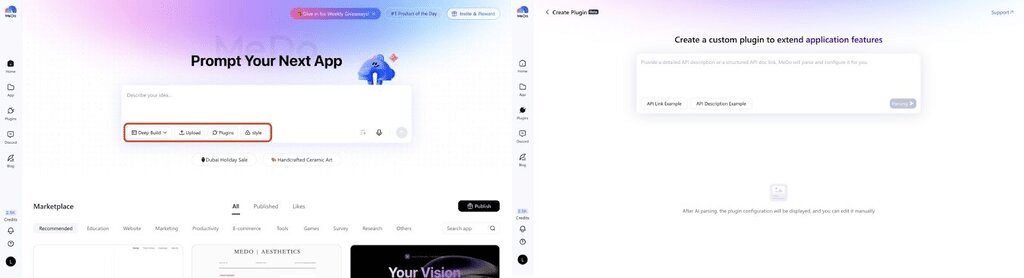
Everything starts with a simple description. Users can either explain what they want to build or upload reference designs showing the structure they like. There is no need to plan databases or technical architecture first.
From there, the system generates the UI, backend logic, and database together. Because everything is created at the same time, the result behaves like a complete application rather than separate pieces.
Changes are also straightforward. Instead of rebuilding from scratch, MeDo allows adjustments through simple instructions. Features can be modified while keeping the rest of the product stable. Earlier versions can also be restored when needed.
Once generated, the app is already live. Users can open it in a browser, share access, and continue improving it as a real product instead of a temporary preview.
Why MeDo Performs Better in Practice
What separates MeDo is how many technical steps it removes. Instead of asking users to connect services or configure infrastructure, it generates frontend, backend, and database together.
This means apps are usable immediately after creation.
Users never need to understand deployment pipelines or database structure. These layers are handled automatically, so beginners can focus on product ideas instead of technical decisions.
Another practical advantage is partial editing. Instead of regenerating everything, small UI or feature changes can be made directly. This feels closer to how real software evolves.
The platform also includes built-in integrations for authentication, payments, and AI features. This allows users to build products that can actually generate revenue.
Beyond simple websites, MeDo also supports SaaS products, interactive tools, and even games with animations and dynamic behavior. This makes it suitable for people who want to grow their ideas without changing platforms later.
Accessible Pricing
MeDo keeps the entry barrier low. New users receive 300 Credits when signing up and an additional 100 Credits daily through login rewards. This allows experimentation before spending anything.
Extra Credits can also be earned through marketplace participation.
Instead of forcing subscriptions immediately, this credit system gives users freedom to test ideas first. That flexibility is important because many projects evolve slowly.
When users are ready to scale, paid plans begin at $20 per month. This creates a clear upgrade path without forcing early commitments.
MeDo vs Lovable vs Base44 vs Replit
Here is how MeDo compares with other popular AI development platforms:
| Feature | MeDo | Lovable | Base44 | Replit |
| Core focus | Full AI app and website builder | AI-focused no-code builder | AI developer platform | Cloud coding environment |
| Main users | Beginners, creators, solo founders | AI product teams and designers | Semi-technical builders | Developers and engineering teams |
| Generation coverage | Frontend, backend and database together | UI and logic with abstracted backend | Full stack with manual setup | Code-driven workflows |
| Deployment | Instant launch with no setup | Simple deployment | Requires extra configuration | User managed deployment |
| Iteration style | Natural language edits with rollback | Regeneration workflow | IDE-style editing | Standard coding workflow |
| Monetization support | Built-in payments and auth plugins | Limited monetization tools | Integration dependent | External libraries required |
| UI quality | Animations and interactive feedback | Clean structured UI | Developer-controlled UI | Code-controlled UI |
| Best use cases | SaaS, tools, games, real products | MVPs and prototypes | Developer tools | Engineering projects |
| Starting price | $20/month | $25/month | $25/month | From $20/month |
| Beginner difficulty | Very low | Low to moderate | Medium | Higher |
Where MeDo Clearly Differentiates Itself
1. Similar outcomes at a lower starting price
For builders trying to launch SaaS products or full applications, MeDo delivers comparable outcomes to platforms like Lovable but at a lower entry cost.
The difference between $20 and $25 per month may seem small, but for students, solo founders, and long development cycles, it adds up.

2. Stronger focus on user experience
Many AI builders focus mainly on functionality. MeDo also pays attention to how products feel to users.
Generated apps often include transitions, animations, and responsive feedback. This makes it particularly useful for consumer apps, creative tools, and interactive products.
3. Built for beginners first
Compared with platforms like Replit or Base44, MeDo assumes less technical knowledge.
It is designed for users who want working results without infrastructure decisions, while still keeping pricing reasonable over time.
Conclusion
In a crowded market of AI builders, the real difference is not how easy a platform looks at first glance. The real test is whether users can actually launch something real.
Many platforms appear simple early on but introduce technical friction later. MeDo stands out because it removes many of those hidden steps.
From first generation to later improvements, the focus stays on building usable products rather than managing infrastructure.
For anyone trying to build apps or websites without a technical background, that practical approach matters more than feature lists. And in real use, that is what makes MeDo feel like one of the strongest no-code AI platforms available today.






Best No-Code AI Platform for Building Apps and Websites in 2026

The Link Between Small Workplace Upgrades and Big Gains in Productivity

Global Labor Trends in Remote Work: Opportunities and Challenges

Why Professional House Cleaning Services Are Worth the Investment?

Instant Serotonin: Generating Cute, Fluffy Animals On S2V With Sora 2 When You Need a Smile

7 Things to Do in Nepal

Android App Development for Internal Business Operations in US

What Company Directors Must Know About the New Companies House Identity Verification Rules

Wide Toe Box Hiking Boots: Preventing Blisters and Injuries on the Trail

Mastering Puppy Potty Training: Expert Steps and Real Owner Solutions

Revolutionizing Healthcare: The Emergence of AI-Driven Analytics

Carol Kirkwood’s Journey: Her Real Age, Husband, Career, and More

Body Positivity and Bodycon: Embrace Your Shape with Homecoming Dresses

How Machine Learning and AI are Redefining the Future?

Aliza Barber: Meet Lance Barber’s Wife, Age, Life, Profile, Career and Net Worth

Evelyn Melendez: Jordan Knight’s Wife Bio, Marriage, Family, Career and Net Worth

Ilan Tobianah Biography: Family, Marriage, Lifestyle, Career and Net Worth

Who was Alice Marrow? Everything to Know About Ice-T’s and His Mother

King Von’s Autopsy Report: The Truth Behind the Tragic Death

Meet Otelia Cox: The Supportive Wife of Tony Cox – A True Fairy Tale Romance
Best No-Code AI Platform for Building Apps and Websites in 2026
The Link Between Small Workplace Upgrades and Big Gains in Productivity
Global Labor Trends in Remote Work: Opportunities and Challenges
Why Professional House Cleaning Services Are Worth the Investment?
Instant Serotonin: Generating Cute, Fluffy Animals On S2V With Sora 2 When You Need a Smile
7 Things to Do in Nepal
Android App Development for Internal Business Operations in US
What Company Directors Must Know About the New Companies House Identity Verification Rules
Wide Toe Box Hiking Boots: Preventing Blisters and Injuries on the Trail
Mastering Puppy Potty Training: Expert Steps and Real Owner Solutions
-
 Health2 years ago
Revolutionizing Healthcare: The Emergence of AI-Driven Analytics
-
 News7 months ago
Carol Kirkwood’s Journey: Her Real Age, Husband, Career, and More
-
 Fashion2 years ago
Body Positivity and Bodycon: Embrace Your Shape with Homecoming Dresses
-
 Technology2 years ago
How Machine Learning and AI are Redefining the Future?