Games
The Real Reason FreeCell Feels Harder Than Solitaire (It’s Not Luck)
Published
26 seconds agoon
By
Admin
The transition from playing classic Klondike Solitaire to playing FreeCell may mean jumping straight from one world of gaming into the other. Solitaire is played at a slow and leisurely pace. But why does it seem like FreeCell is harder to play than the typical Solitaire? Because in FreeCell, Solitaire becomes a challenging game where one slip-up makes everything futile.
While most players think FreeCell is more challenging because of overly stringent rules, there is one aspect that makes this game harder. It is the element of luck that is eliminated in FreeCell but still remains in the traditional Solitaire. Removing the safety net of chance changes how you must approach every single decision, and you can practice it by playing Freecell online.
Why Is FreeCell So Hard? Hidden Cards vs Perfect Information
The psychological impact of how information is presented explains why so many players struggle when transitioning to this game variant.
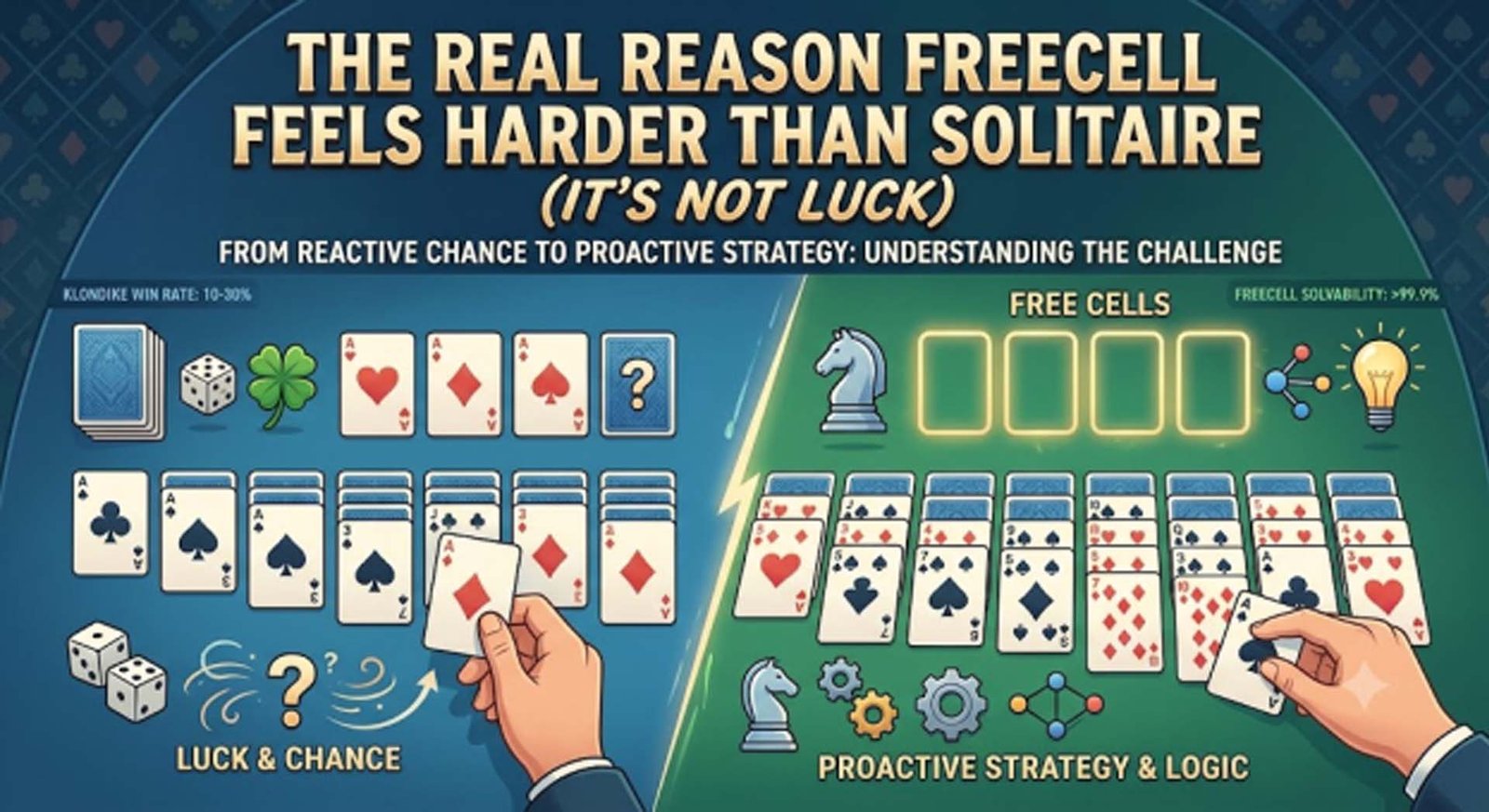
In classic Klondike Solitaire, you deal with partial information. A massive portion of the deck sits face-down in the tableau or remains tucked away in the draw pile. Because you cannot see those cards, your success depends heavily on fortunate draws.
When a game of Klondike ends in a dead end, it is easy to blame bad luck. The game design gives you a convenient excuse for losing. FreeCell completely strips away that excuse through a concept game designers call perfect information.
When you learn how to set up FreeCell, all 52 cards are dealt completely face-up across eight tableau columns right from the second zero. No secret cards, no reserve pile, and no surprise at all! As every deal in FreeCell is solvable from the mathematical point of view, failure implies just one factor, failure in the process of calculating your moves. The absence of luck means that every error you make is especially serious.
The Free Cell Trap: Is FreeCell Harder Than Solitaire for Beginners?
The four open spaces at the top of the board, the free cells, give the game its name, but they also set a dangerous trap for inexperienced players.
When you start a new match, those four empty cells look like endless freedom. Beginners often treat them like extra attic storage, tossing troublesome cards into the open cells whenever a tableau column gets cluttered.
However, FreeCell operates on strict physical movement limits that depend directly on your open spaces:
| Board State | Available Card Transfer Limit |
| 4 Free Cells Open / 0 Empty Columns | Can move up to 5 cards at once |
| 2 Free Cells Open / 0 Empty Columns | Can move up to 3 cards at once |
| 0 Free Cells Open / 0 Empty Columns | Can move only 1 card at a time |
| 0 Free Cells Open / 1 Empty Column | Can move up to 2 cards at once |
As soon as you fill up all four free cells with random cards, you will be unable to move any multi-card sequence. In Klondike, a random draw from the deck can salvage a board that is in utter chaos. In FreeCell, as soon as you fill up all your four free cells, the game becomes deadlocked.
FreeCell vs Solitaire: Reactive Flipping vs Proactive Strategy
Another major factor in the freecell vs Solitaire difficulty debate is how your brain processes each game during play.
Classic Solitaire is primarily a reactive game. You flip a card from the deck, see if it matches an open space, and play it. You are constantly responding to new information as it gets revealed. The mental focus required is relatively light, making it an easy way to unwind.
FreeCell is strictly proactive. Because every card is visible right away, the game demands the same style of long-range planning you would use in a game of chess or checkers:
- Unburying Low Cards: You must actively trace where the Aces and Deuces are hidden beneath longer columns before making your opening move.
- Calculating Sequence Mobility: You have to calculate whether you will have enough empty spaces to transfer a long sequence before you start moving pieces around.
- Creating Empty Columns: You must plan several turns ahead to clear out an entire tableau column, which acts as the ultimate tool for organizing cards.
Tracing complex, branching paths in your head makes FreeCell one of the most effective freecell games for the brain.
The Win Rate Reality: Is FreeCell Harder Than Solitaire?
When evaluating whether is freecell harder than solitaire, the contrast between player perception and statistical reality reveals a major surprise: while FreeCell feels significantly harder, it is statistically much easier to win.
The contrast in potential win rates between the two games shows just how much luck influences standard Solitaire:
- Klondike Solitaire Win Rate: The average player wins around 10% to 30% of their games. Even with theoretical perfect play where all hidden cards are known in advance, only about 79% to 82% of deals are physically winnable.
- FreeCell Win Rate: Over 99.9% of standard, randomly numbered deals are fully solvable. In the famous original set of 32,000 Microsoft deals, only a single game (Game #11982) was proven to be completely unwinnable.
FreeCell is not harder because the game is rigged against you. The reason why is that it becomes more difficult by turning a game of luck into an exercise of visual logic. The moment you change your perception of the game and start using strategy, your chances of winning will become immensely higher.
How to Win FreeCell: Easy Strategy Tips for Beginners
If you want to stop getting stuck and learn how to win freecell consistently, apply an easy freecell strategy built around these three fundamental rules:
1. Free the Aces and Deuces First
Your primary goal in the opening moves should always be uncovering the lowest cards. Getting Aces and Deuces up to the foundation piles early opens up critical room across the tableau.
2. Guard Your Free Cells Like Treasure
Never place a card into a free cell unless you already know how and when you are going to get it back out. Try to keep at least two free cells completely empty at all times to maintain your sequence movement power.
3. Prioritize Empty Columns Over Free Cells
An empty tableau column is infinitely more valuable than an empty free cell. An empty column allows you to store entire organized suit sequences rather than just a single isolated card. Clear out shallow columns as fast as possible to build powerful movement hubs.
Conclusion
The FreeCell game seems much more difficult than standard Solitaire since there is absolutely no luck involved; only calculating moves is required. But since nearly all deals are winnable, the transition from an erratic card flipping method to a calculated approach is all that’s needed to win the game.
You may like

The Real Reason FreeCell Feels Harder Than Solitaire (It’s Not Luck)
Melissa McKnight: Everything About Matt LeBlanc’s Ex-Wife
Anna Axster: The Filmmaker Behind Ryan Bingham’s Story and Her Own Success
A First-Time Buyer’s Guide to Buying a Home in Basingstoke
Breaking the Scalability Barrier: Designing Lean Growth Frameworks with Conversational Tech
Inside Jeff Tietjens’ Life: His Legal Career, Marriage, Divorce, Aisha Tyler’s Ex-Husband
Who Is Frances Beatrix Spade? Inside the Life of Kate Spade’s Daughter
Debbie Rosado: The Early Life Full Story of Marc Anthony’s First Love and Family Life
Who Is Jackson Foo Wong? Inside the Life of BD Wong’s Son
Leland Francis Fraser: Inside the Life of Brendan Fraser’s Youngest Son
Revolutionizing Healthcare: The Emergence of AI-Driven Analytics
Carol Kirkwood’s Journey: Her Real Age, Husband, Career, and More
Body Positivity and Bodycon: Embrace Your Shape with Homecoming Dresses
Aliza Barber: Meet Lance Barber’s Wife, Age, Life, Profile, Career and Net Worth
How Machine Learning and AI are Redefining the Future?
Evelyn Melendez: Jordan Knight’s Wife Bio, Marriage, Family, Career and Net Worth
Ilan Tobianah Biography: Family, Marriage, Lifestyle, Career and Net Worth
Who was Alice Marrow? Everything to Know About Ice-T’s and His Mother
King Von’s Autopsy Report: The Truth Behind the Tragic Death
Tea Leoni and Tim Daly Split – A Closer Look at Their Relationship and Breakup
The Real Reason FreeCell Feels Harder Than Solitaire (It’s Not Luck)

Melissa McKnight: Everything About Matt LeBlanc’s Ex-Wife
Anna Axster: The Filmmaker Behind Ryan Bingham’s Story and Her Own Success
A First-Time Buyer’s Guide to Buying a Home in Basingstoke
Breaking the Scalability Barrier: Designing Lean Growth Frameworks with Conversational Tech
Inside Jeff Tietjens’ Life: His Legal Career, Marriage, Divorce, Aisha Tyler’s Ex-Husband
Who Is Frances Beatrix Spade? Inside the Life of Kate Spade’s Daughter
Debbie Rosado: The Early Life Full Story of Marc Anthony’s First Love and Family Life
Who Is Jackson Foo Wong? Inside the Life of BD Wong’s Son
Leland Francis Fraser: Inside the Life of Brendan Fraser’s Youngest Son
Category
Trending
-
Health3 years agoRevolutionizing Healthcare: The Emergence of AI-Driven Analytics
-
News12 months agoCarol Kirkwood’s Journey: Her Real Age, Husband, Career, and More
-
Fashion2 years agoBody Positivity and Bodycon: Embrace Your Shape with Homecoming Dresses
-
Celebrity2 years agoAliza Barber: Meet Lance Barber’s Wife, Age, Life, Profile, Career and Net Worth