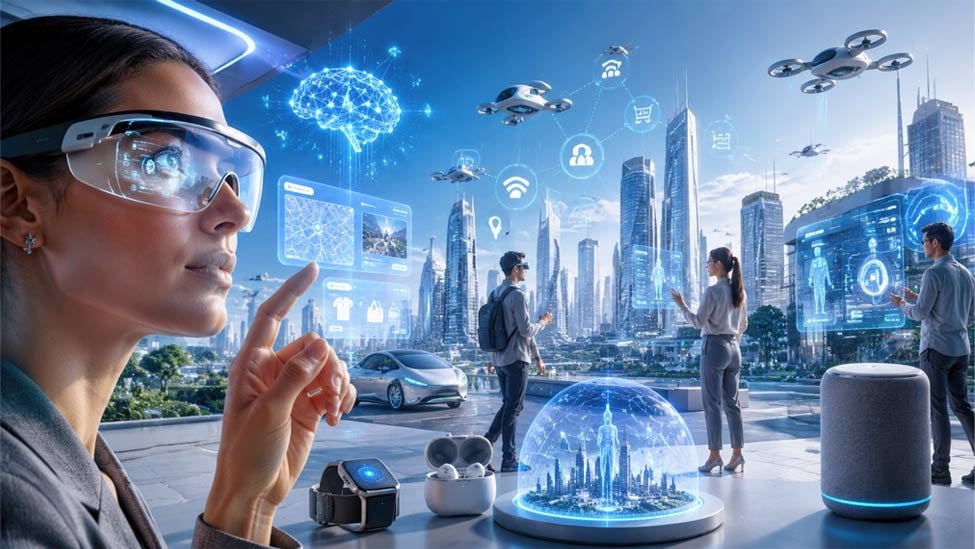
For almost twenty years, smartphones have been the center of our digital lives. We use them to call family, send messages, shop online, watch videos, play games, work, and even control smart home devices. They have changed the way people live, learn, and connect with the world.
But today, something new is happening. Tech giants envision future beyond smartphones, and they are spending billions of dollars to build the next generation of personal technology. Instead of depending on one screen in your hand, future devices may work naturally around you through artificial intelligence (AI), smart glasses, wearable devices, and even brain-computer interfaces.
This change will not happen overnight. Smartphones are still growing in many markets, and millions of people buy new phones every year. However, many experts believe the smartphone market is becoming mature. Companies now see the next big opportunity in devices that are smaller, smarter, and easier to use without constantly looking at a screen.
Some reports estimate that leading technology companies have already invested more than $150 billion in technologies linked to the post-smartphone era. They believe this could become a multi-trillion-dollar market over the next decade as AI becomes more powerful and wearable technology improves.
In this article, you will learn why companies like Apple, Meta, Google, Microsoft, OpenAI, and Neuralink are working toward this future. We will also explore the technologies behind this change, the biggest challenges they still face, and what everyday life may look like if smartphones are no longer the main way we use technology.
Why Smartphones May Lose Their Lead
Smartphones are still very popular, but the market is not growing as quickly as it once did. Most people already own a smartphone, and new models often bring only small improvements instead of exciting new features. Because of this, many users now keep the same phone for several years before upgrading.
Technology companies know they cannot depend on smartphones forever. Just as mobile phones replaced landlines and smartphones replaced many other devices, companies believe another major change will eventually happen. They are already preparing for that future by creating new ways for people to interact with technology.
Another reason for this shift is changing user habits. People want faster and easier ways to get information while walking, driving, working, or exercising. Taking a phone out of a pocket every few minutes is not always convenient. Hands-free technology can make many daily tasks simpler and more natural.
Artificial intelligence is also changing what devices can do. Modern AI can understand speech, recognize objects, translate languages, answer questions, and even understand what is happening around the user. These abilities make it possible for devices to work without relying only on touchscreens.
Privacy is another important factor. Many users want more control over how their personal data is collected and used. Future devices will need stronger privacy protection, better security, and clearer ways to manage personal information if they are going to earn public trust.
Many industry experts believe smartphones will not disappear completely. Instead, they may slowly become one part of a much larger digital ecosystem where smart glasses, wearables, AI assistants, and connected devices work together throughout the day.
What Comes After Smartphones?
If smartphones are no longer the center of personal technology, what comes next? Different companies have different ideas, but most agree that future devices will be lighter, smarter, and much more connected to artificial intelligence.
One of the biggest ideas is smart glasses. Instead of looking down at a phone, users could see directions, messages, translations, weather updates, and reminders directly in front of their eyes. Voice commands and hand gestures could replace many touchscreen actions.
Wearable devices are also becoming more powerful. Smartwatches already track health, answer calls, and show notifications. Future smart rings, earbuds, AI pins, and other wearables may work together to provide information without needing a phone in your hand.
Another important idea is ambient computing. This means technology quietly works in the background without asking users to open apps or press buttons. Devices understand what people need based on their surroundings, voice, location, calendar, and daily habits.
Artificial intelligence makes this possible. Instead of waiting for commands, AI may remind you about meetings, suggest faster travel routes, translate conversations, control smart home devices, or even organize your work before you ask.
Some companies are also exploring brain-computer interfaces (BCIs). These systems allow computers to receive signals directly from the human brain. Today, this technology mainly focuses on helping people with serious medical conditions, but researchers believe it could become more advanced in the future.
Spatial computing is another growing area. Instead of using a flat phone screen, digital windows, videos, and workspaces appear around you. Users can move, resize, and interact with digital content naturally inside their environment, making work and entertainment feel much more immersive.
At first, these technologies will probably work together with smartphones instead of replacing them. Over time, as hardware improves and users become comfortable with new devices, some smartphone tasks may gradually move to smart glasses, AI assistants, and other wearable technology.
How AI Is Changing Personal Technology
Artificial intelligence is the biggest reason tech giants envision future beyond smartphones. AI is no longer limited to chatbots or search engines. It is becoming the brain behind many future devices by helping them understand people, their surroundings, and their daily routines.
Modern AI can understand spoken language, recognize faces and objects, read text from signs, translate conversations instantly, and answer questions naturally. Instead of opening several apps, users may simply ask an AI assistant to complete many tasks at once.
Future AI assistants may also learn personal habits over time. They could remind users to leave early for appointments because of traffic, suggest healthier routines, organize daily schedules, or recommend useful information based on location and activity.
Another important improvement is multimodal AI. This means AI can understand different types of information together, including voice, pictures, video, movement, and text. This makes future wearable devices much more helpful because they understand what users are seeing as well as what they are saying.
Many companies are also moving AI directly onto devices instead of relying completely on cloud servers. On-device AI works faster, improves privacy, and continues working even with limited internet access. New processors from companies like Apple, Google, and Qualcomm are designed to handle these AI tasks more efficiently.
AI is also changing communication. Future devices may provide real-time language translation, identify landmarks during travel, explain objects through a camera, and help people with visual or hearing challenges. These features can make technology more useful for many different users.
However, AI also creates new concerns. Devices that constantly listen, watch, or collect information could raise privacy questions if companies do not protect user data properly. Strong security, clear privacy rules, and user control will remain very important as AI becomes part of everyday life.
Meta’s Plan for Smart Glasses
Meta has become one of the biggest companies investing in life beyond smartphones. Over the past several years, it has spent tens of billions of dollars through its Reality Labs division to develop augmented reality, virtual reality, and AI-powered wearable technology.
One of Meta’s biggest successes has been the Ray-Ban Meta smart glasses. Unlike earlier smart glasses that looked unusual, these glasses were designed to look like normal eyewear. They combine cameras, microphones, speakers, and AI features while keeping a familiar style that many users feel comfortable wearing.
Meta is also working on more advanced AR glasses, including projects often linked with the name Hypernova. These future glasses are expected to display digital information directly in front of the user while supporting voice commands, live AI assistance, navigation, messaging, and real-time visual understanding.
To strengthen its position, Meta invested billions of dollars in EssilorLuxottica, the company behind well-known eyewear brands like Ray-Ban and Oakley. This partnership shows that Meta wants smart glasses to be fashionable as well as powerful, helping them appeal to everyday users instead of only technology fans.
Live AI is another major part of Meta’s strategy. Instead of simply responding to commands, future AI could understand what users are looking at, answer questions about nearby objects, provide helpful suggestions, and support natural conversations throughout the day.
Even with this progress, several challenges remain. Advanced prototypes can still be expensive to produce, battery life is limited, and engineers continue working to make displays smaller, brighter, and more energy efficient. These improvements will be important before smart glasses become as common as smartphones.
Meta believes smart glasses could eventually become one of the world’s most popular personal devices. However, reaching that goal will require better hardware, lower prices, longer battery life, and public trust in how wearable AI collects and protects personal data.
Apple’s Move Into Spatial Computing
Apple is taking a different path from many of its rivals. Instead of trying to replace the iPhone right away, the company is building a larger ecosystem where different devices work together. This is why Apple often talks about spatial computing, where digital content becomes part of the space around you.
The first big step was the Apple Vision Pro headset. It showed how people can open apps, watch videos, join meetings, and work with large virtual screens placed around them. Although the headset received praise for its technology, its high price and weight made it difficult for many people to use every day.
Reports also suggest that Apple is working on lighter smart glasses for the future. These glasses are expected to display directions, messages, reminders, and other useful information while connecting closely with the iPhone. Instead of replacing the phone completely, they may first use the phone’s power for many tasks.
Apple’s biggest strength is its ecosystem. Macs, iPads, Apple Watches, AirPods, and iPhones already work together smoothly. Future wearable devices are expected to fit into this system, making it easier for users to move between devices without losing their work or information.
The company is also investing heavily in better displays, faster AI chips, and improved battery technology. These improvements are needed before lightweight smart glasses can become practical for everyday use.
Even so, Apple still faces challenges. Lower prices, better comfort, and longer battery life will be important before spatial computing becomes common in homes, schools, and offices.
OpenAI and Ambient AI
While some companies focus mainly on hardware, OpenAI is focused on making artificial intelligence available everywhere. Its long-term goal is to build AI that naturally becomes part of everyday life instead of living inside only one device.
This idea is called ambient AI. Rather than waiting for users to open an app, AI stays ready to help whenever needed. It understands conversations, surroundings, schedules, and personal habits to provide useful support at the right time.
For example, future AI could remind you about traffic before leaving home, adjust smart home settings automatically, organize your daily tasks, summarize meetings, or answer questions simply by listening to your voice.
OpenAI is also working with robotics companies, including Figure AI, to bring advanced AI into physical machines. Combined with AI agents that can complete tasks on their own, this shows that future computing may happen across many devices instead of only smartphones.
The company is also interested in new AI hardware. Instead of depending completely on today’s phones or computers, future AI devices may be designed from the beginning to support natural conversations, voice commands, cameras, and sensors.
At the same time, privacy remains one of the biggest concerns. AI systems that constantly understand surroundings must protect personal information carefully. Strong privacy rules and user control will be necessary as ambient AI becomes more common.
Microsoft and Mixed Reality at Work
Microsoft has taken a slightly different approach from companies like Apple and Meta. Instead of focusing mainly on everyday consumers, it has spent years building mixed reality tools for businesses, factories, hospitals, schools, and engineering teams.
The company’s HoloLens headset allows users to see digital objects placed on top of the real world. Workers can receive repair instructions, view building designs, or join remote experts without taking their hands away from their work.
Microsoft also combines these tools with Azure cloud services and AI. This allows devices to recognize objects, understand workplaces, and provide useful information in real time.
Many industries already use mixed reality for employee training, medical education, product design, manufacturing, and maintenance. These practical uses show that wearable computing is already helping businesses improve productivity.
Microsoft continues to improve AI features that recognize tools, machines, and work environments. As the hardware becomes smaller and less expensive, similar technology could eventually reach more everyday users.
Although HoloLens is not replacing smartphones today, Microsoft’s work proves that hands-free computing can solve real problems in many industries long before it becomes common at home.
Brain-Computer Interfaces and Neuralink
One of the most interesting ideas for the future is the brain-computer interface, often called a BCI. Instead of using fingers, voice, or gestures, these systems allow computers to receive signals directly from the human brain.
Neuralink, founded by Elon Musk, is one of the best-known companies working in this area. Its N1 implant is designed to help people control computers using brain signals. Early work has focused mainly on helping people with paralysis regain more independence.
Other companies, including Synchron, are exploring less invasive ways to build similar systems. Researchers believe BCIs may improve healthcare first before expanding into other areas of computing.
In the future, brain-computer interfaces may help people control wheelchairs, communicate more easily, operate robotic arms, or interact with digital devices without physical movement. These medical uses could improve many lives.
However, this technology also raises important questions. Safety, privacy, ethics, and long-term health effects must all be studied carefully before BCIs become more common.
For now, brain-computer interfaces remain an exciting area of research rather than a replacement for smartphones. Their biggest impact during the coming years will likely be in medicine and accessibility.
The Biggest Problems Still to Solve
Although tech giants envision future beyond smartphones, several important challenges still stand in the way. The biggest one is battery life. Smart glasses and wearable devices are much smaller than phones, leaving less space for large batteries.
Companies are working on better battery technology, including solid-state batteries that may store more power while charging faster. Researchers are also exploring wireless charging and energy harvesting from body heat or movement, but these ideas still need more development.
Display technology is another challenge. Smart glasses must be light, comfortable, and easy to wear all day. New waveguide displays, retinal projection systems, and even holographic displays are being developed to improve image quality without making devices heavy.
Processing power is equally important. Modern chips such as Apple’s latest processors, Google’s Tensor chips, and Qualcomm’s XR platforms are designed to run AI faster while using less energy. Many companies also combine on-device AI with cloud computing to balance speed and battery life.
Privacy is one of the biggest concerns for users. Glasses with cameras, microphones, and AI assistants may collect large amounts of personal information. Companies will need strong security, clear privacy settings, and transparent data policies to build public trust.
Cybersecurity is another growing issue. As more devices stay connected all day, protecting personal information becomes even more important. Future wearable technology will need stronger security than ever before.
Social acceptance also matters. Some people still feel uncomfortable wearing devices with cameras in public. Better design, clear privacy signals, and stylish products may help smart glasses become more accepted over time.
Finally, cost remains a major barrier. Early mixed reality headsets and advanced smart glasses are expensive. As production grows and technology improves, prices will likely fall, allowing more people to use these devices.
Bottom Line
The smartphone changed the world, but the next big technology shift has already started. As tech giants envision future beyond smartphones, they are investing in AI, smart glasses, wearable devices, spatial computing, mixed reality, and brain-computer interfaces to create a more natural way of using technology. While many technical and privacy challenges still need to be solved, the direction is becoming clearer. The future is unlikely to depend on one device alone. Instead, it will be built around connected, intelligent tools that work together to help people in every part of daily life.
(FAQs)
Will smart glasses completely replace smartphones?
Probably not right away. Most experts believe smart glasses will first work together with smartphones. Over time, they may take over many daily tasks as the technology becomes more advanced.
Why is artificial intelligence so important in future devices?
AI allows devices to understand voice, images, locations, and user habits. This makes technology faster, more personal, and easier to use without constantly opening apps or touching a screen.
What are the biggest challenges before smartphones can be replaced?
The biggest challenges include battery life, high prices, privacy concerns, cybersecurity, comfortable designs, better displays, and making wearable devices powerful enough for everyday use.
What is ambient computing?
Ambient computing is a system where technology quietly works in the background. Devices understand your needs and provide help naturally without requiring you to open apps or press many buttons.
When could post-smartphone technology become common?
There is no exact date. Many experts expect smart glasses, AI wearables, and spatial computing to become much more common during the late 2020s and early 2030s, but smartphones will likely remain part of daily life for many years.
Also Read: AnonVault Guide: Everything BenefitsAbout Its Features, Security, and