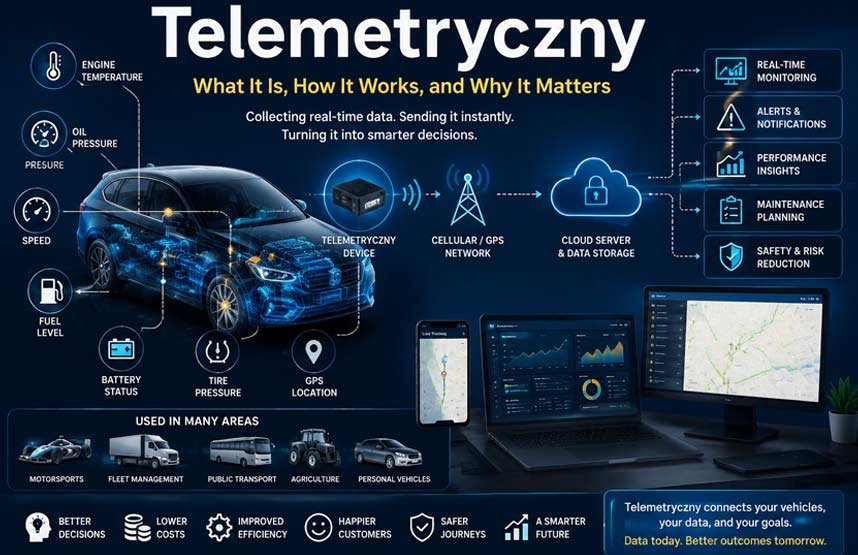
Cars today do much more than take us from one place to another. Many modern vehicles can collect useful information while they are moving. They can report engine health, fuel use, speed, location, and even how safely someone is driving. This is possible because of telemetryczny technology.
You may have heard the word telemetryczny while reading about smart cars, fleet management, racing, or connected vehicles. At first, the term may sound difficult, but the idea behind it is actually quite simple. It is all about collecting information and sending it somewhere else so people or software can study it in real time.
This technology is becoming more common every year. Delivery companies use it to manage fleets. Racing teams use it to improve performance. Car makers use it to build safer vehicles. Even everyday drivers benefit from it through maintenance alerts and better safety features.
In this article, you’ll learn what telemetryczny means, how it works, where it is used, its main parts, the different systems available, and why it is becoming one of the most important technologies in modern transportation.
What Is Telemetryczny?
The word telemetryczny comes from the idea of telemetry, which means measuring information from one place and sending it somewhere else without needing someone to check it by hand. In simple words, it lets a vehicle or device “talk” by sharing useful information automatically.
In the automotive world, telemetryczny refers to systems that collect data from a vehicle using different sensors. The collected information is then sent through wireless communication to a computer, cloud server, or fleet management platform where it can be viewed and studied.
Instead of waiting until something breaks, telemetryczny allows owners, mechanics, or fleet managers to see what is happening while the vehicle is on the road. This makes it easier to solve problems early and keep vehicles running safely.
Today, telemetryczny is used in personal cars, buses, trucks, taxis, delivery vehicles, construction equipment, emergency vehicles, and even race cars. As connected vehicle technology grows, telemetry systems are becoming a normal part of transportation.
Why Telemetryczny Is Important Today
Vehicles have become much smarter than they were just a few years ago. They now create large amounts of information every second. Without telemetryczny systems, much of this valuable data would never be used.
One of the biggest reasons telemetryczny matters is safety. The system can warn drivers or fleet managers about engine problems, low tire pressure, battery issues, overheating, or unusual driving before they become serious problems.
Businesses also depend on telemetryczny because it improves fleet management. Managers can see where every vehicle is, monitor fuel use, reduce idle time, and plan better routes. This saves both time and money.
As electric vehicles, connected cars, and self-driving technology continue to grow, telemetryczny has become one of the main tools that keeps these systems working smoothly. It helps vehicles make better decisions while giving owners more control.
How Does Telemetryczny Work?
Although the technology sounds advanced, the process follows a simple chain of steps. Everything starts with collecting information from the vehicle.
Modern vehicles contain many sensors that measure things like engine temperature, fuel level, speed, tire pressure, battery condition, engine performance, braking, acceleration, steering, GPS location, and even G-forces during driving. OBD-II diagnostic systems also provide important vehicle health information.
Once the sensors collect this information, communication modules send it wirelessly. Depending on the system, this may happen through GSM, GPRS, GPS, 4G, 5G, Wi-Fi, or other mobile communication networks.
The information then reaches cloud servers or fleet management software. Here, powerful software studies the data using algorithms and artificial intelligence. These systems look for patterns, detect unusual behavior, and predict possible problems before they happen.
Finally, the results appear on dashboards, websites, mobile apps, or control centers. Drivers and fleet managers receive reports, maintenance reminders, alerts, maps, and recommendations that help them make better decisions every day.
Main Parts of a Telemetryczny System
Every telemetryczny system has several important parts that work together. Each part has its own job, but all of them help collect, send, and understand vehicle information.
The first part is the sensor. Sensors measure many different values inside the vehicle. Some monitor engine temperature, while others watch speed, fuel use, oil pressure, battery health, braking, or tire pressure.
Another important part is the GPS receiver. It records the vehicle’s location, travel route, speed, and direction. This allows businesses and vehicle owners to know exactly where a vehicle is at any time.
Communication modules are equally important. GSM, GPRS, LTE, and 5G modules send information from the vehicle to cloud systems without requiring physical cables. Wireless communication makes real-time monitoring possible almost anywhere with network coverage.
The cloud platform stores all collected information. Fleet software then organizes the data into reports, graphs, alerts, and live dashboards. Artificial intelligence and machine learning can also study the information to predict maintenance needs and improve vehicle performance.
What Information Does Telemetryczny Collect?
One of the biggest strengths of telemetryczny is the wide range of information it can collect. Modern systems gather much more than simple GPS tracking.
Vehicle performance data includes engine speed, engine temperature, oil pressure, battery condition, fuel consumption, fuel level, tire pressure, mileage, and transmission health. This information helps detect problems early and supports predictive maintenance.
Driving behavior is another important area. The system records acceleration, braking, cornering, speeding, idle time, seat belt use, and driving habits. Companies often use this information to improve road safety and reduce fuel costs.
Location information is collected through GPS. Fleet operators can view live locations, travel history, delivery routes, arrival times, and geofencing alerts whenever a vehicle enters or leaves a selected area.
Some advanced telemetryczny systems also collect environmental information, equipment status, accident data, vehicle diagnostics, and even driver health information. Wearable devices such as Polar telemetry straps can monitor heart rate and fatigue during long trips or racing events.
Common Telemetryczny Devices and Modules
Many different devices are used to build a complete telemetryczny system. Some collect information, while others focus on communication or health monitoring.
GPS trackers are among the most common devices. They monitor vehicle location, travel history, speed, and route information. OBD-II modules connect directly to the vehicle and read diagnostic information from the engine and other onboard systems.
The article also mentions several GSM and GPRS telemetry modules. Devices such as the MT-020, CMB-03, and iMod X1000 send vehicle information through mobile communication networks. These modules support real-time monitoring, event logging, alarms, remote control, and vehicle diagnostics.
Driver health can also be monitored using wearable devices. Polar telemetry straps, including the Polar H7 and Polar T34, measure heart rate and help detect fatigue. Although originally made for fitness and sports, they can support driver safety during long working hours.
Another device mentioned is the Holter telemetry monitor. It is mainly used in healthcare to record heart activity over one or two days. While it is not a standard automotive tool, similar health-monitoring ideas may help improve driver safety in special situations.
Types of Fleet Telemetry Systems
Fleet telemetry systems are not all the same. Some are simple and watch only one value. Others collect many kinds of information from many vehicles at the same time. The right choice depends on the size of the fleet and the type of work being done.
A single-channel system measures one main value. It may track only temperature, fuel level, pressure, or location. These systems are often cheaper and easier to use, but they give a limited view of the vehicle.
A multi-channel system collects several kinds of data at once. It may record speed, fuel use, engine health, location, mileage, driver actions, and cargo temperature. This gives managers a clearer picture of how each vehicle is working.
Selective systems can measure several values but may send only the data needed at a certain time. This can save battery power, mobile data, and storage space. It is useful when every reading does not need to be sent live.
Systems may also be wired or wireless. Wired systems often give a steady link inside a vehicle, but they can be harder to install. Wireless systems use radio, GSM, GPRS, 4G, 5G, or Wi-Fi. They are easier to set up but may face weak signals in some places.
Main Uses in Fleet Management
GPS tracking is one of the best-known fleet uses. It shows where each vehicle is, where it has been, and which route it followed. Managers can use this data to plan better routes, give more accurate arrival times, and respond quickly when plans change.
Remote vehicle management gives managers a broad view of fleet activity. They can check mileage, fuel use, service dates, driver habits, and vehicle health from one dashboard. This reduces the need to call every driver or check every vehicle by hand.
Driver ID systems link a person to a certain trip or vehicle. They may use a key fob, card, code, or mobile app. This improves duty records and makes it easier to study driving habits fairly.
Accelerometer-based tools record sudden movement. They can find hard braking, quick starts, sharp turns, or possible crashes. A phone may sometimes provide this data, though a fixed device often gives more steady results.
Geofencing lets a company draw a virtual area on a map. The system sends an alert when a vehicle enters or leaves that area. This can help with security, delivery proof, work zone control, and route rules.
Vehicle-to-vehicle links may also help fleets share useful data. In the future, these links may support safer group travel, traffic warnings, and better movement between fleet vehicles.
Special and Safety Systems
Some telemetry systems are linked to road rules, tolls, cargo control, or emergency support. Their use can depend on the country, vehicle type, and work being done.
The SENT GEO system is used in Poland for certain goods that need official movement checks. It uses location data to help track transport under local tax and road rules. It should not be described as a general system for all EU or EFTA transport, because its main role is tied to Polish law.
Electronic toll systems use vehicle location or road-side tools to calculate fees. They can record when a vehicle enters a paid road and charge the correct amount. This saves time at toll points and can help transport firms manage road costs.
The eCall system can contact emergency services after a serious crash. It may send the location of the vehicle and basic event data. This can help rescue teams reach the scene faster, especially when the driver cannot make a call.
Tachograph systems are also important in commercial transport. They record driving time, rest time, speed, and work hours. This helps firms and drivers follow road safety rules and avoid unsafe working hours.
Best Ways to Use Telemetryczny Data
A good telemetry project should begin with a clear goal. A business should know what it wants to improve before buying devices or collecting data. The goal may be lower fuel use, fewer crashes, better routes, faster service, or less downtime.
It is also wise to collect only useful information. More data is not always better. Extra data can raise storage costs, slow reports, and create privacy risks. A small and clear data set is often easier to use well.
The right link method also matters. The CAN bus is widely used inside vehicles for messages between vehicle parts. Outside the vehicle, systems may use mobile networks, Wi-Fi, or satellite links. MQTT and HTTP may be used to move data between devices and online systems.
Important safety data should be sent first. A crash alert, brake fault, or high engine heat needs quick delivery. Less urgent data, such as a daily mileage report, can be sent later or in groups.
Data compression can reduce file size before sending. This saves mobile data and may improve speed in places with weak coverage. The system should still keep the data correct and readable after it reaches the server.
Software and device updates are also important. Updates can fix faults, improve features, and close security gaps. A company should have a clear update plan instead of waiting for a problem to appear.
Data Safety and Privacy
Vehicle data can reveal a lot. It may show where a person travels, how fast they drive, when they stop, and where they spend time. Because of this, telemetry data must be handled with care.
Encryption should protect information while it is being sent and while it is stored. Strong login rules, limited access, and clear user roles can stop many common problems. Staff should only see the data they need for their work.
Companies should also explain what they collect and why. Drivers should know which details are recorded, how long the data is kept, and who can see it. Hidden tracking can harm trust and may break privacy rules.
In Europe, GDPR rules may apply when vehicle data can be linked to a person. Other countries have their own privacy and worker rules. Firms should check the laws that match their location and type of work.
HIPAA is mainly a United States health privacy law. It may matter only when a telemetry system handles protected health data through a health service or related group. It is not a normal rule for every vehicle telemetry system.
Challenges of Telemetryczny Systems
One major challenge is cost. A full system may need sensors, tracking devices, mobile data, cloud tools, software, fitting, updates, and staff training. Small firms may need to begin with a basic setup and add more features later.
Older vehicles can also be hard to connect. They may not support modern ports, software, or data rules. Extra hardware may be needed, and some readings may not be available at all.
Weak network coverage can cause missing or late data. This often happens in rural areas, tunnels, mountains, or crowded networks. A good device should store data for a short time and send it later when the link returns.
Poor sensor data is another risk. A broken, loose, or poorly set sensor may send wrong values. That can lead to false alerts or bad choices. Regular checks and proper fitting help keep the data useful.
Large fleets may also face scale problems. As more vehicles and sensors are added, the system must handle more messages, reports, users, and storage. The cloud platform should be able to grow without becoming slow or too costly.
Staff may resist the system if they feel watched or do not understand its purpose. Clear rules, open talks, and fair use of the data can reduce this problem. Training should show how the system supports safety and better work, not only control.
Future of Telemetryczny in 2026 and Beyond
Faster mobile networks are making vehicle links quicker and more steady. 5G is already helping systems send more data with less delay in supported areas. Work on 6G continues, but wide public use is still years away.
Vehicle-to-Everything, also called V2X, may become more common. It allows vehicles to share signals with roads, traffic lights, other vehicles, and nearby systems. This could give earlier warnings about crashes, road work, traffic, or danger ahead.
Edge computing will also play a larger role. Instead of sending every detail to the cloud, the vehicle can study some data itself. This is useful when a quick choice is needed, such as finding a safety risk or helping a driver system react.
AI can study large sets of vehicle data and find patterns that people may miss. It may help predict part failure, plan service, spot waste, or find unsafe driving. Still, AI results should be checked, because poor data can lead to poor advice.
Digital twins may also become more useful. A digital twin is a computer copy of a real vehicle or machine. It uses live data to show how the real item is working and may help test changes before they are made.
More cars will also receive over-the-air updates. These updates can fix software, add features, and improve control systems without a workshop visit. Strong security checks are needed so only safe and approved updates reach the vehicle.
Bottom Line
Telemetryczny is not one single product. It is a general term linked to telemetry-based tools and systems. These tools collect data, send it to another system, and help people make better choices.
When used well, vehicle telemetry can lower costs, improve safety, reduce breakdowns, and make fleet work easier. It is a powerful tool, but it should always be used with clear goals, good data, strong security, and respect for privacy.
(FAQs)
Can telemetry help stop vehicle breakdowns?
It cannot stop every breakdown, but it can warn users about early signs of trouble. This allows service work to be planned before a small fault becomes a major problem.
Is vehicle telemetry legal?
It is usually legal when used under local rules. Companies must clearly explain what data they collect and protect personal information. Worker tracking and location data may have special legal limits.
Does telemetry work without the internet?
Some devices can still collect and store data without a live link. They may send the saved data later when mobile or internet service returns. Live tracking will not work well during the loss of connection.
Can small businesses use telemetry systems?
Yes. Small firms can begin with simple GPS, fuel, and service tools. They do not need a large or costly system at the start. The setup can grow as the fleet grows.
What is the difference between telemetry and telematics?
Telemetry means measuring and sending data. Telematics is a wider field that combines vehicle data, communication, GPS, software, maps, and fleet tools. Telemetry is often one part of a telematics system.
Also Read: What Is Olympus Scanlation? A Simple Guide for New Readers